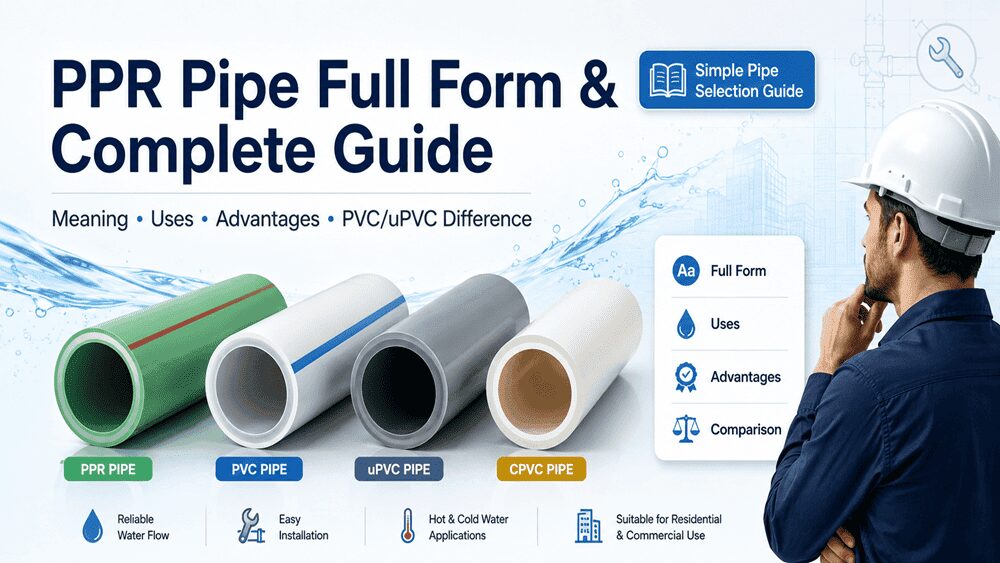
PPR Pipe Full Form: Meaning, Uses, Advantages & Difference from PVC/uPVC
Choosing the right pipe for a home, building, plumbing system, or water supply project can be confusing. Many people search for PPR pipe full form before selecting a pipe, but only knowing the full form is not enough.
You should also know where PPR pipe is useful, where it is not suitable, what its advantages are, and how it is different from PVC, uPVC, and CPVC pipes.
In this guide, we will explain PPR pipe in simple words. You will understand its full form, meaning, uses, fittings, benefits, limitations, and selection tips. This guide is helpful for homeowners, plumbers, builders, contractors, dealers, and anyone who wants to understand pipe selection better.
What is the Full Form of PPR Pipe?
PPR stands for Polypropylene Random Copolymer.
PPR pipe is a plastic plumbing pipe commonly used for hot and cold water supply in homes, apartments, hotels, hospitals, offices, and commercial buildings. People know that it can stand up to heat and rust, let water flow smoothly, and have strong heat-fusion joints.
What is PPR Pipe?
PPR pipe is a thermoplastic pipe used mainly in plumbing and water supply systems. It is made from polypropylene random copolymer material, which makes it suitable for carrying hot and cold water.
PPR pipes are commonly used inside buildings for water distribution. They are popular because they do not rust like metal pipes and can provide a strong joint when installed properly.
The most important feature of PPR pipe is its jointing method. PPR pipes and fittings are joined using a heat fusion process. In this method, both the pipe and fitting are heated and then joined together. After cooling, the joint becomes strong and leak-resistant.
This is different from some other pipe systems where glue, solvent, or threaded joints are used.
PPR Pipe Full Form in Plumbing
In plumbing, PPR pipe full form is Polypropylene Random Copolymer pipe.
It is mostly used for internal plumbing systems where hot and cold water supply is required. For example, it can be used in bathrooms, kitchens, wash areas, hotels, hospitals, apartments, and commercial plumbing lines.
Many people also search for terms like:
- PPR full form
- PPR pipe meaning
- What is PPR pipe?
- PPR pipe uses
- PPR pipes and fittings
- PPR vs PVC pipe
- PPR vs uPVC pipe
- PPR vs CPVC pipe
All these searches are related to understanding whether PPR pipe is the right choice for a specific plumbing application.
PPR Pipes and Fittings: What Are They?
A piping system is not made only with straight pipes. It also needs fittings to change direction, connect pipes, reduce pipe size, close the line, or control water flow.
Common PPR pipe fittings include:
- Elbow: Used to change pipe direction.
- Tee: Used to divide one pipeline into two directions.
- Coupler: Used to connect two pipes in a straight line.
- Reducer: Used to connect pipes of different sizes.
- Socket: Used for pipe connection.
- Union: Used where the pipe section may need to be removed later.
- Valve: Used to control water flow.
- End cap: Used to close the pipe end.
- Male and female adapter: Used to connect PPR pipe with threaded fittings.
Using the right fittings is very important. A good quality pipe with poor quality fittings can still create leakage problems. That is why pipe, fittings, installation tools, and plumber skill all matter in a proper plumbing system.
Main Uses of PPR Pipe
PPR pipes are mainly used in plumbing and water supply systems. Below are the most common applications.
1. Residential Plumbing
PPR pipes are used in homes, flats, villas, and apartments for internal water supply. They are commonly used in bathrooms, kitchens, and wash areas.
2. Hot and Cold Water Supply
One of the main uses of PPR pipe is hot and cold water distribution. Because of its heat resistance, PPR is commonly selected for plumbing lines where hot water is used.
3. Commercial Buildings
Hotels, hospitals, schools, offices, malls, and commercial buildings may use PPR pipes for internal plumbing systems.
4. Building Water Distribution
PPR pipes can be used for distributing water inside buildings. The correct pipe size and pressure rating should be selected according to the project requirement.
5. HVAC and Heating Systems
In some cases, PPR pipes are used in heating and HVAC-related water systems. However, the final selection should depend on temperature, pressure, and system design.
6. Industrial Water Lines
PPR pipes may be used in some industrial water supply systems. But for chemical or high-pressure applications, compatibility should always be checked before selection.
Advantages of PPR Pipe
PPR pipe has many benefits, especially for plumbing applications.
1. Suitable for Hot and Cold Water
PPR pipe can handle hot and cold water supply. This makes it useful for bathrooms, kitchens, and building plumbing systems.
2. Corrosion Resistant
PPR pipe does not rust like metal pipes. This helps maintain water flow and reduces corrosion-related damage.
3. Strong Heat-Fusion Joints
PPR pipes and fittings are joined using heat fusion. If the installation is done properly, the joint becomes strong and reduces leakage risk.
4. Smooth Inner Surface
PPR pipe has a smooth inner surface. This helps water flow easily and reduces friction inside the pipe.
5. Lightweight and Easy to Handle
Compared to metal pipes, PPR pipes are lightweight. This makes transportation, handling, and installation easier.
6. Low Maintenance
Because PPR pipe is corrosion-resistant and has a smooth surface, it usually requires less maintenance when installed correctly.
7. Long Service Life
Good quality PPR pipes can last for many years if used in the right application and installed properly.
8. Good for Indoor Plumbing
PPR is commonly used for indoor plumbing systems where hot and cold water lines are required.
Limitations of PPR Pipe
PPR pipe is useful, but it is not perfect for every application. Knowing its limitations helps users make the right decision.
1. Skilled Installation is Required
PPR pipe needs heat fusion jointing. If the plumber does not use the correct heating time, temperature, and alignment, the joint may become weak.
2. Special Tools Are Needed
PPR pipe installation requires a heat fusion welding machine. It cannot be joined like normal solvent-based pipes.
3. Not Ideal for Every Application
PPR is mainly suitable for plumbing. It may not be the right choice for drainage, borewell, agriculture, underground sewerage, or some outdoor applications.
4. Outdoor Use Needs Care
If PPR pipes are exposed to direct sunlight, they may need protection depending on the site condition and material quality.
5. Poor Installation Can Cause Leakage
Even if the pipe quality is good, poor installation can lead to leakage. Proper cutting, cleaning, heating, joining, and pressure testing are important.
Where PPR Pipe Should Not Be Used
PPR pipe should not be used blindly for every project. It is mainly a plumbing pipe, not a universal pipe for all applications.
PPR pipe may not be the best choice for:
- Drainage lines
- Sewerage systems
- Borewell casing
- Agriculture irrigation lines
- High-impact outdoor applications
- Underground sewer systems
- Long outdoor exposure without protection
- Applications where a different pipe material is technically better
For example, for agriculture water supply or underground water movement, HDPE pipes may be more suitable depending on pressure and site conditions. For drainage applications, SWR pipes or UDS pipes may be more suitable. For borewell applications, column pipes or casing pipes are commonly used.
The right pipe always depends on the application.
PPR Pipe vs PVC Pipe
Many people confuse PPR and PVC pipes because both are plastic pipes. But their use is different.
| Point | PPR Pipe | PVC Pipe |
|---|---|---|
| Full form | Polypropylene Random Copolymer | Polyvinyl Chloride |
| Main use | Hot and cold water plumbing | Cold water, drainage, general piping |
| Hot water suitability | Better | Limited |
| Jointing method | Heat fusion | Solvent cement |
| Installation | Needs fusion machine | Easier with solvent joining |
| Common use | Building plumbing | Drainage, water supply, irrigation |
PPR is usually better for hot and cold water plumbing. PVC is commonly used in cold water, drainage, and general piping applications.
PPR Pipe vs uPVC Pipe
uPVC stands for unplasticized polyvinyl chloride. It is widely used in water supply, pressure systems, drainage, borewell, and agriculture applications depending on the pipe type.
| Point | PPR Pipe | uPVC Pipe |
| Material | Polypropylene Random Copolymer | Unplasticized Polyvinyl Chloride |
| Best for | Hot and cold water plumbing | Cold water, pressure, drainage, agriculture, borewell |
| Jointing | Heat fusion | Solvent, rubber ring, or threaded system |
| Hot water use | Suitable | Usually limited |
| Common area | Indoor plumbing | Water supply, drainage, agriculture, borewell |
If the requirement is hot and cold water plumbing, PPR can be suitable. But for cold water supply, agriculture, pressure lines, and other water distribution applications, uPVC pressure pipes may be a better option depending on the project requirement.
PPR Pipe vs CPVC Pipe
CPVC is another popular pipe used for hot and cold water plumbing. Both PPR and CPVC are used in plumbing, but they are different in material and installation method.
| Point | PPR Pipe | CPVC Pipe |
| Main use | Hot and cold water plumbing | Hot and cold water plumbing |
| Jointing method | Heat fusion | Solvent cement |
| Installation | Needs fusion tool | Needs correct solvent application |
| Leakage risk | Low if fused properly | Low if solvent joint is done properly |
| Selection depends on | Pressure, temperature, installer skill | Pressure, temperature, solvent quality |
Both can be suitable for plumbing. The better choice depends on project requirement, water temperature, pressure rating, budget, installation quality, and availability of trained plumbers.
PPR vs PVC vs uPVC vs CPVC: Quick Comparison
| Pipe Type | Best For | Hot Water Use | Common Jointing | Main Limitation |
| PPR | Hot/cold plumbing | Yes | Heat fusion | Needs skilled installation |
| PVC | Drainage/general water | Limited | Solvent cement | Not ideal for hot water |
| uPVC | Cold water, pressure, drainage, borewell | Limited | Solvent/ring/threaded | Not mainly used for hot water |
| CPVC | Hot/cold plumbing | Yes | Solvent cement | Needs correct solvent application |
This table helps users understand that no single pipe is best for every use. The best pipe depends on where and how it will be used.
How to Choose the Right Pipe for Your Project
Many people choose pipes only by price, but that is not the right method. A low-cost pipe can become expensive later if it fails or needs frequent repair.
Before selecting any pipe, check these points:
1. Application
First, identify the use. Is the pipe for hot water, cold water, drainage, borewell, agriculture, or underground supply?
2. Water Temperature
If the pipe will carry hot water, choose a material suitable for hot water plumbing.
3. Pressure Requirement
Every pipe has a pressure rating. Select the correct class according to water pressure and system design.
4. Indoor or Outdoor Use
Outdoor pipes may face sunlight, weather, and temperature changes. Some pipes need extra protection.
5. Jointing Method
PPR uses heat fusion. CPVC uses solvent cement. uPVC may use solvent, rubber ring, or threaded joining depending on the pipe type.
6. Fittings Compatibility
Always use compatible fittings. Mixing low-quality fittings with good quality pipes can create leakage problems.
7. Installation Quality
A trained plumber and correct tools are important. Poor installation can damage even a good pipe system.
8. Long-Term Maintenance
Choose a pipe that is suitable for long-term use and requires less maintenance for your application.
Buying Checklist Before Choosing PPR Pipe
Before buying PPR pipe, check:
- Pipe material quality
- Pressure rating
- Temperature suitability
- Pipe size
- Fittings compatibility
- Brand reliability
- Potable water suitability
- Installation method
- Plumber experience
- Warranty or quality assurance
- Indoor or outdoor use
- Site condition
This checklist helps avoid wrong pipe selection and future leakage problems.
Which Pipe is Best for Which Application?
Here is a simple application-based guide:
| Application | Suitable Pipe Options |
| Hot water plumbing | PPR / CPVC |
| Cold water plumbing | uPVC / CPVC |
| Agriculture water supply | uPVC / HDPE |
| Borewell use | Column pipe / casing pipe |
| Drainage system | SWR pipe / UDS pipe |
| Irrigation system | HDPE / sprinkler pipe |
| Commercial plumbing | PPR / CPVC / uPVC depending on requirement |
| Underground water supply | uPVC / HDPE depending on pressure and soil condition |
This is a general guide. Final selection should always depend on site requirement, pressure, temperature, installation method, and expert advice.
Common PPR Pipe Installation Mistakes
A good piping system depends on correct installation. Here are common mistakes to avoid:
1. Wrong Heating Temperature
If the pipe and fitting are not heated properly, the joint may become weak.
2. Overheating the Pipe
Too much heat can damage the pipe end and reduce the internal flow area.
3. Underheating the Joint
If the pipe is not heated enough, the fitting may not bond properly.
4. Poor Alignment
Pipe and fitting should be aligned correctly during joining. Wrong alignment can create stress on the joint.
5. Dirty Pipe Surface
Dust, oil, or moisture can affect joint quality. The pipe surface should be clean before fusion.
6. Wrong Fittings
Using incompatible or low-quality fittings can create leakage and performance issues.
7. No Pressure Testing
After installation, pressure testing is important to check leakage and system strength.
8. Ignoring Outdoor Protection
If the pipe is installed outdoors, proper protection may be needed depending on exposure conditions.
Is PPR Pipe Good for Drinking Water?
PPR pipes are commonly used for drinking water supply in many plumbing systems. However, pipe quality is very important.
Before using any pipe for drinking water, check:
- Material quality
- Potable water suitability
- Product standard
- Brand reliability
- Fittings quality
- Installation process
For drinking water systems, selection should not be based only on low price. Good material and proper installation are important for safety and long-term performance.
Is PPR Pipe Good for Hot Water?
Yes, PPR pipe is commonly used for hot water plumbing. It has good heat resistance and can be used in hot and cold water supply systems.
However, the correct pipe class, pressure rating, and installation method are important. If the pipe is not installed correctly, leakage or joint failure may happen.
Is PPR Pipe Better Than PVC?
PPR is better than PVC for hot water plumbing because it has better heat resistance. But PVC may be better for drainage, cold water, and general piping applications.
So, the answer depends on use:
- For hot water plumbing: PPR or CPVC may be suitable.
- For drainage: PVC/uPVC/SWR systems may be suitable.
- For agriculture water supply: uPVC or HDPE may be suitable.
- For borewell: Column pipe or casing pipe may be suitable.
No pipe is best for every application. The best pipe is the one that matches the project requirement.
Final Thoughts
PPR pipe is a popular plumbing pipe used mainly for hot and cold water supply. Its full form is Polypropylene Random Copolymer. It is known for heat resistance, corrosion resistance, smooth flow, and strong heat-fusion joints.
But PPR pipe is not the right choice for every project. For drainage, borewell, agriculture, underground water supply, or pressure applications, other pipe systems like uPVC, HDPE, SWR, UDS, column, or casing pipes may be more suitable.
The right pipe should always be selected based on application, pressure, temperature, site condition, installation method, and long-term performance requirement.
In simple words, do not choose a pipe only because it is popular. Choose a pipe because it is right for your use.
FAQs About PPR Pipe
1. What is the full form of PPR?
PPR stands for Polypropylene Random Copolymer.
2. What is PPR pipe full form?
PPR pipe full form is Polypropylene Random Copolymer pipe.
3. What is PPR pipe used for?
PPR pipe is mainly used for hot and cold water plumbing in homes, apartments, hotels, hospitals, offices, and commercial buildings.
4. What is the meaning of PPR?
PPR means Polypropylene Random Copolymer. It is a plastic material used for making plumbing pipes and fittings.
5. Is PPR pipe suitable for hot water?
Yes, PPR pipe is suitable for hot water plumbing when the correct pressure rating and proper installation method are used.
6. What are PPR pipes and fittings?
PPR pipes and fittings are plumbing components used to build water supply systems. Fittings include elbows, tees, couplers, reducers, valves, sockets, and end caps.
7. What is the difference between PPR and PVC pipe?
PPR is mainly used for hot and cold water plumbing. PVC is commonly used for cold water, drainage, and general piping applications.
8. What is the difference between PPR and uPVC pipe?
PPR is commonly used for indoor plumbing and hot water supply. uPVC is widely used for cold water supply, pressure lines, drainage, agriculture, and borewell applications.
9. Which is better, PPR or CPVC pipe?
Both PPR and CPVC are used for hot and cold water plumbing. The better choice depends on pressure, temperature, budget, installation method, and project requirement.
10. Is it okay to use PPR pipe outside?
PPR pipe can be used outdoors only with proper protection if required. Direct sunlight and weather exposure may affect some piping systems over time.