uPVC vs HDPE Pipe: Differences, Uses & Which Is Better?
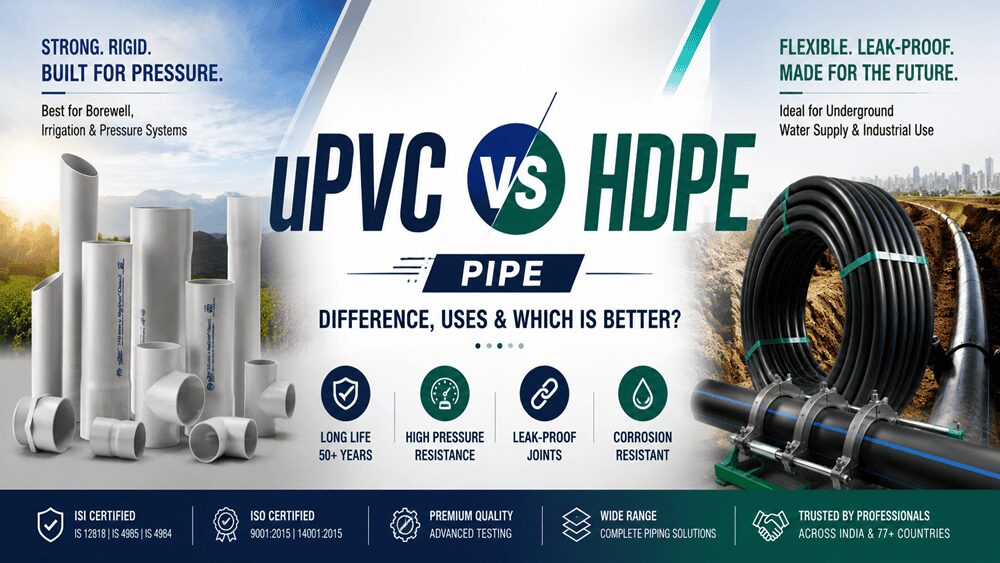
Choosing between uPVC and HDPE pipes depends on the application, pressure requirements, installation environment, terrain, jointing method and overall project design.
uPVC pipes are rigid and commonly used for fixed water-supply lines, irrigation, plumbing and specialised borewell casing systems. HDPE pipes are flexible and are widely used for underground water supply, long pipeline runs, uneven terrain and applications where flexibility is important.
Neither material is universally better. The right choice depends on where and how the pipe will be used.
uPVC vs HDPE Pipe
Choose uPVC pipes when you need a rigid and cost-efficient piping system for fixed pressure lines, irrigation or purpose-designed borewell casing.
Choose HDPE pipes when flexibility, underground installation, uneven terrain, long pipeline runs or fusion jointing are important.
For both materials, the correct pipe should ultimately be selected according to its diameter, pressure rating, material grade, installation conditions and applicable technical standards.
uPVC vs HDPE Pipe Comparison
| Factor | uPVC Pipe | HDPE Pipe |
|---|---|---|
| Structure | Rigid | Flexible |
| Flexibility | Low | High |
| Typical Jointing | Solvent, rubber-ring or threaded systems depending on product | Butt fusion, electrofusion or approved mechanical fittings |
| Corrosion Resistance | Excellent | Excellent |
| Underground Use | Suitable for correctly designed buried systems | Well suited to flexible buried pipelines |
| Irrigation | Excellent for fixed pressure networks | Excellent for flexible and long-distance layouts |
| Borewell Use | Common for specialised casing and screen systems | Depends on the function and system design |
| Uneven Terrain | Requires fittings for direction changes | Better suited to gradual route changes |
| Installation | Conventional installation methods | Fusion may require specialised equipment |
| Cost | Depends on size, pressure class and fittings | Depends on PE grade, SDR and installation |
| Best Suited For | Rigid, fixed piping systems | Flexible and long-distance piping systems |
The comparison above provides general guidance. Actual pipe performance depends on the product specification, pressure class, diameter, installation method and operating conditions.
What Is a uPVC Pipe?
uPVC stands for Unplasticized Polyvinyl Chloride. It is a rigid thermoplastic material widely used in water-supply, irrigation, plumbing, borewell and infrastructure piping systems.
Unlike flexible PVC products, uPVC does not rely on plasticizers for flexibility. This gives the finished pipe its rigid structure.
Common applications include:
- Agricultural irrigation
- Water-supply pipelines
- Pressure pipelines
- Plumbing systems
- Borewell casing
- Borewell screen pipes
- Selected drainage applications
- Industrial water conveyance
Businesses, contractors and project planners can explore Duke Pipes’ range of uPVC pipes for different water-supply, plumbing, irrigation and borewell applications.
Key Benefits of uPVC Pipes
- Rigid construction
- Corrosion resistance
- Lightweight handling
- Smooth internal surface
- Low routine maintenance
- Multiple sizes and pressure classes
- Suitable for fixed piping layouts
Different uPVC products are engineered for different applications. For example, a pressure pipe should not automatically be treated as the same product as a specialised borewell casing pipe.
What Is an HDPE Pipe?
HDPE stands for High-Density Polyethylene. It is a flexible thermoplastic piping material commonly used for water transportation, irrigation, underground pipelines and infrastructure projects.
One of the major differences between HDPE and uPVC is flexibility. HDPE can accommodate gradual bends within specified limits, which can reduce the need for directional fittings in suitable installations.
Common HDPE applications include:
- Underground water supply
- Agricultural irrigation
- Long-distance water transportation
- Municipal water networks
- Industrial pipelines
- Uneven terrain
- Selected trenchless installations
- Infrastructure projects
For projects where flexibility and underground performance are important, explore Duke Pipes’ HDPE pipe solutions.
Key Benefits of HDPE Pipes
- High flexibility
- Good impact resistance
- Corrosion resistance
- Suitable for long buried pipelines
- Can accommodate gradual route changes
- Compatible with heat-fusion joining
- Useful where soil or ground movement must be considered
What Is the Difference Between uPVC and HDPE Pipes?
The primary difference between uPVC and HDPE pipes is their structural behaviour.
uPVC is rigid, while HDPE is flexible.
This difference affects installation, jointing, underground performance, terrain suitability and application selection.
1. Rigidity and Flexibility
uPVC retains its rigid form during installation.
Where a uPVC pipeline needs to change direction, appropriate fittings such as elbows and bends are generally required.
HDPE has much greater flexibility and can follow gradual changes in direction within the manufacturer’s specified bending limits.
Practical choice:
- Fixed and planned pipeline → uPVC
- Flexible or uneven route → HDPE
2. Pressure Performance
It is not technically accurate to say that one pipe material is automatically stronger than the other.
Both uPVC and HDPE pipes are available in different:
- Diameters
- Wall thicknesses
- Pressure classes
- Material grades
- Dimensional classifications
A properly selected uPVC pressure pipe can perform effectively in irrigation and fixed water-supply systems.
HDPE is also available in multiple grades and pressure ratings.
Therefore, the correct comparison should be based on the actual product specifications, rather than only the material name.
3. Jointing Method
uPVC and HDPE use different jointing techniques.
Depending on the product, uPVC piping systems may use:
- Solvent-cement joints
- Rubber-ring joints
- Threaded connections
- Application-specific fittings
HDPE piping systems commonly use:
- Butt fusion
- Electrofusion
- Approved mechanical connections
Properly executed fusion joints can create a continuous HDPE piping system.
However, correct equipment, surface preparation, installation conditions and trained operators are important for reliable joint performance.
4. Leakage Considerations
Neither uPVC nor HDPE should simply be described as completely leak-proof.
Leakage performance depends on:
- Joint quality
- Installation
- Pipe condition
- Fittings
- Operating pressure
- Workmanship
- Site conditions
HDPE fusion joining can reduce the number of traditional mechanical joints in long pipeline installations.
Correctly installed uPVC systems can also provide reliable water transportation when appropriate fittings and installation practices are used.
5. Underground Performance
Both uPVC and HDPE pipes can be used in underground systems when the selected pipe is designed and installed correctly.
uPVC Can Be Suitable When:
- Ground conditions are relatively stable
- A rigid pipeline is preferred
- Proper trench preparation is followed
- Correct bedding is provided
- The appropriate pressure class is selected
HDPE Can Be Suitable When:
- Flexibility is important
- The terrain is uneven
- Long pipeline runs are required
- Ground movement needs to be considered
- Fusion joining is preferred
- A suitable trenchless installation method is used
HDPE’s flexibility gives it an advantage in applications where the pipeline needs to accommodate movement or gradual route changes.
6. uPVC vs HDPE for Borewell Applications
The question “Which pipe is best for a borewell?” requires more context because a borewell system may use different pipes for different functions.
uPVC Casing Pipes for Borewells
Purpose-designed uPVC casing pipes are commonly used as structural lining in bore and tubewell installations.
Their rigid structure makes them suitable for protecting the borehole and helping prevent surrounding soil from entering the bore.
Duke Pipes offers specialised uPVC casing pipes for borewell applications in different series for varying installation depths and conditions.
When choosing casing pipe, factors such as the following should be considered:
- Bore depth
- Bore diameter
- Ground formation
- Pipe size
- Wall thickness
- Joint design
- Screen requirement
- Installation conditions
Can HDPE Be Used in Borewell Systems?
It is better not to say that HDPE is unsuitable for every borewell-related application.
A complete borewell system may include:
- Casing pipes
- Screen pipes
- Column or riser pipes
- Surface water-delivery pipelines
Each component performs a different function.
Purpose-designed uPVC casing pipes are widely used for structural borewell casing, while HDPE may be suitable for related water-conveyance applications when its specifications meet the project requirements.
7. Which Pipe Is Better for Irrigation?
Both uPVC and HDPE pipes can perform well in agricultural irrigation systems.
Choose uPVC for Irrigation When:
- The pipeline follows a fixed route
- A rigid pressure line is required
- Conventional fittings suit the system
- The land layout is relatively straightforward
- Cost efficiency is important
Choose HDPE for Irrigation When:
- Fields have uneven terrain
- Pipeline flexibility is important
- Long-distance transportation is required
- The route changes gradually
- Fusion joining is preferred
Other factors should also be considered:
- Water-flow requirement
- Pump capacity
- Pipeline length
- Operating pressure
- Pipe diameter
- Terrain
- Installation cost
In general: uPVC can be an excellent option for fixed pressure irrigation networks, while HDPE can offer advantages for flexible and long-distance agricultural layouts.
8. Which Pipe Is Better for Underground Water Supply?
For underground water-supply applications, HDPE is often considered when flexibility and ground movement are important.
HDPE can be useful for:
- Long buried pipelines
- Uneven terrain
- Gradual route changes
- Projects designed around fusion joining
- Applications where ground movement is expected
However, HDPE is not automatically better for every underground system.
Properly specified uPVC pipes can also perform effectively in buried water-supply installations when trench preparation, bedding and pressure class meet the project’s requirements.
Bottom line: choose according to site conditions rather than assuming one material is always better underground.
9. Durability and Service Life
Both uPVC and HDPE are corrosion-resistant polymer materials.
Unlike many metallic piping systems, they do not rust in the conventional sense.
Actual service life depends on several factors, including:
- Operating pressure
- Temperature
- Pipe material and grade
- Installation quality
- Joint quality
- Environmental exposure
- Water or transported fluid
- Pressure cycles
- Site conditions
Avoid choosing a pipe based only on a generic lifespan figure. Always check the applicable standard and the manufacturer’s technical specifications.
10. Temperature Resistance
Temperature affects the operating conditions of both uPVC and HDPE piping systems.
uPVC is widely used for normal cold-water transportation and irrigation.
HDPE can also perform across a range of environmental conditions, although its allowable operating pressure may change with temperature.
For unusual operating temperatures, check:
- Manufacturer limits
- Pressure derating requirements
- Application standards
- Actual fluid temperature
11. Chemical and Corrosion Resistance
Both materials offer good corrosion resistance.
However, chemical compatibility depends on factors such as:
- Chemical type
- Concentration
- Temperature
- Pressure
- Exposure duration
- Pipe formulation
For industrial applications, always check manufacturer-approved chemical resistance information before selecting the pipe.
12. uPVC vs HDPE Pipe Cost
There is no fixed rule that uPVC is always cheaper and HDPE is always more expensive.
Total piping-system cost depends on:
- Diameter
- Pressure rating
- Wall thickness
- Material grade
- SDR
- Pipeline length
- Number of fittings
- Jointing method
- Labour
- Excavation
- Fusion equipment
- Transportation
- Installation conditions
uPVC can be cost-efficient for many conventional fixed pipeline systems.
HDPE may require specialised joining equipment, but its flexibility can provide advantages on long or complex pipeline routes.
Therefore, compare the total installed project cost, not just the price per metre.
uPVC vs PVC vs HDPE: Are They the Same?
No.
PVC is the broader term for polyvinyl chloride.
uPVC, or unplasticized polyvinyl chloride, is a rigid form commonly used for piping and construction applications.
HDPE, or high-density polyethylene, is a different thermoplastic material that offers significantly greater flexibility.
Many people search for PVC vs HDPE pipe, but for rigid water-supply and irrigation applications, the more accurate comparison may be uPVC vs HDPE pipe.
uPVC vs HDPE: Which Pipe Should You Choose?
Choose uPVC Pipe If:
- You need a rigid pipeline
- The route is fixed
- You need a specified pressure system
- You are installing a fixed irrigation network
- You require purpose-designed borewell casing
- Conventional installation methods suit your project
Choose HDPE Pipe If:
- Flexibility is important
- The route crosses uneven terrain
- Long underground pipeline runs are required
- Ground movement needs to be considered
- Fusion joining is preferred
- The pipeline follows gradual route changes
Simple Selection Rule
Do not choose a pipe only because someone describes it as stronger, cheaper or longer-lasting.
Compare:
Application + pressure rating + diameter + material grade + installation environment + relevant standard + total project cost.
Duke Pipes uPVC and HDPE Solutions
Duke Pipes provides piping solutions for agriculture, water supply, borewell, plumbing and infrastructure applications.
Depending on your project, suitable options may include:
- uPVC Pressure Pipes
- uPVC Casing Pipes
- uPVC Column Pipes
- HDPE Pipes
- Agricultural piping systems
- Plumbing and drainage systems
The correct product should always be selected according to the latest Duke Pipes technical specifications for the required size, pressure class, series and application.
Frequently Asked Questions
Which is better: uPVC or HDPE pipe?
Neither is better for every project. uPVC is rigid and works well for fixed pressure pipelines, irrigation systems and specialised borewell casing. HDPE provides greater flexibility and can be advantageous for underground pipelines, uneven terrain and projects where ground movement must be considered.
What is the main difference between uPVC and HDPE pipe?
The main difference is rigidity. uPVC is rigid, while HDPE is flexible. This affects installation methods, jointing, directional changes and the way the pipeline behaves in underground and uneven-terrain applications.
Is HDPE better than uPVC for underground water supply?
HDPE can offer an advantage where flexibility, long pipeline runs or ground movement are important. However, properly specified uPVC can also perform effectively underground. The right material depends on soil conditions, pressure requirements and installation design.
Which pipe is better for irrigation?
uPVC is often suitable for fixed pressure irrigation systems, while HDPE can be useful for long or flexible layouts across uneven fields. Operating pressure, flow rate, pipeline length and terrain should determine the final selection.
Which pipe is best for borewell casing?
Purpose-designed uPVC casing pipes are commonly used for borewell casing because rigidity and structural support are important in this application. The correct casing series should be selected according to bore depth, diameter and site conditions.
Is HDPE stronger than uPVC?
It is better to compare their characteristics rather than simply call one stronger. uPVC offers rigidity, while HDPE provides greater flexibility and impact tolerance. Actual performance depends on pipe grade, pressure rating, diameter and wall thickness.
Which is cheaper: uPVC or HDPE?
The cost depends on pipe size, pressure rating, quantity, fittings and installation method. uPVC can be economical for conventional fixed systems, while HDPE may offer installation advantages for long and flexible pipeline routes.
Conclusion
The uPVC vs HDPE pipe comparison does not have a single winner.
Choose uPVC when your project requires a rigid piping system, fixed pressure pipeline, irrigation network or purpose-designed borewell casing.
Choose HDPE when flexibility, underground movement, uneven terrain, long pipeline runs or fusion joining are important.
Most importantly, select a pipe according to its diameter, pressure rating, material grade, application, installation conditions and relevant technical specifications.
If you are unsure which piping system fits your application, you can contact Duke Pipes for project-specific product guidance.