
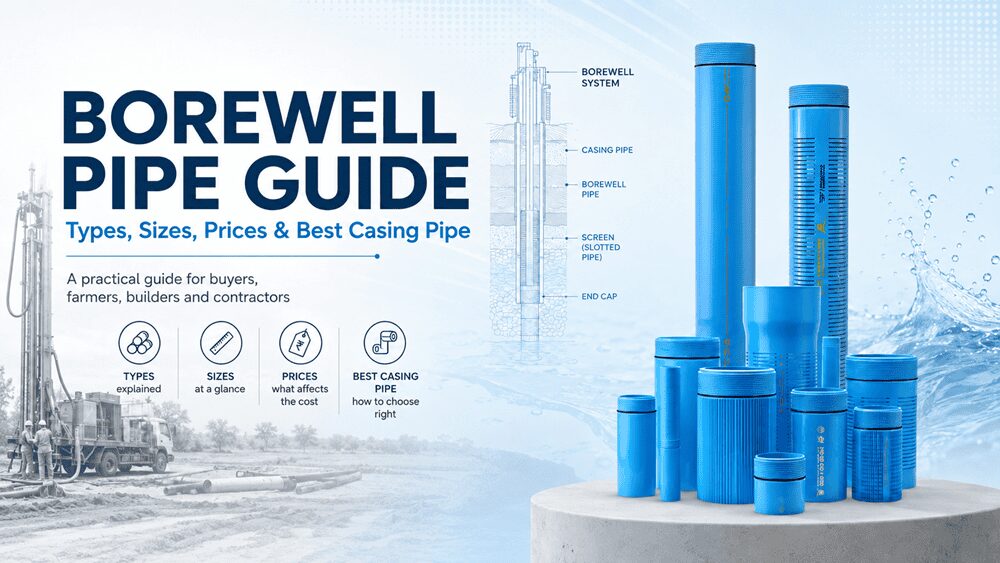
Borewell Pipe Guide: Types, Sizes, Prices and Best Casing Pipe
Choosing the wrong pipe can put your complete borewell investment at risk.
A farmer, homeowner or builder may spend heavily on drilling, a submersible pump, electrical work and installation. If the casing pipe deforms, a joint separates or the pump cannot move freely inside the bore, repair may become difficult and expensive.
That is why you should not choose a borewell pipe only by colour, weight or the lowest quotation. The pipe must match the bore depth, drilled diameter, ground formation, pump size and intended application.
This guide explains borewell pipe types, common sizes, price factors and practical selection points for Indian buyers.
A borewell pipe is part of the piping system installed inside or connected to a drilled groundwater well. Depending on its purpose, it may support the bore wall, allow groundwater to enter, hold a submersible pump or carry pumped water to the surface.
What Is a Borewell Pipe?
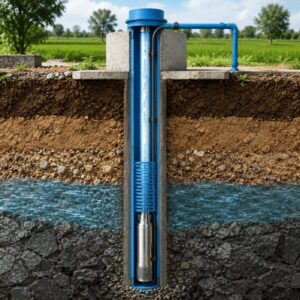
The term borewell pipe is commonly used for different products, but every pipe in a borewell system does not perform the same job.
A complete borewell installation may include:
- Plain casing pipe
- Slotted screen pipe
- Submersible column pipe
- Delivery pipe
- Borewell cover
A borewell casing pipe is installed inside the drilled hole. Its main purpose is to support loose soil, gravel or unstable ground formations that could otherwise fall into the bore.
A slotted screen pipe contains controlled openings. These slots allow groundwater to enter from selected water-bearing zones.
A column pipe connects the submersible pump to the surface. It supports the pump assembly and carries water upwards.
A delivery pipe transfers water from the wellhead to a tank, house, farm or distribution line.
This difference is important. A casing pipe and a submersible column pipe are not interchangeable.
What Are the Main Types of Borewell Pipes?
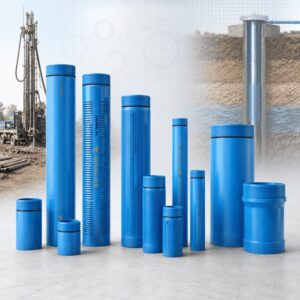
Borewell pipes can be classified according to their material and function.
uPVC Casing Pipes
uPVC casing pipes are widely considered for borewell and tubewell projects because they are corrosion-resistant and comparatively easy to transport and install.
IS 12818:2010 is the relevant Indian Standard for PVC-U screen and casing pipes used in bore and tubewells.
Duke Pipes manufactures uPVC casing pipes under IS 12818:2010 in CS, CM and CD series. According to the official Duke Pipes product specifications:
- CS Series is listed for installation depths up to 80 metres.
- CM Series is listed for installation depths up to 150 metres.
- CD Series is listed for installation depths up to 450 metres.
The final series should still be selected according to the bore diameter, ground formation and project requirements.
Slotted Screen Pipes
A slotted casing or screen pipe allows groundwater to enter the bore through specially designed openings.
The screen section should be installed across the correct water-bearing formation. Installing screen pipes randomly may allow excess sand to enter or may block a productive water zone.
The drilling log, soil conditions and local groundwater information should guide screen placement and slot selection.
Steel or GI Pipes
Steel and GI pipes may be used where the well design requires metal casing or higher mechanical strength.
However, metal pipes are heavier to transport and lower into a bore. Their suitability also depends on water chemistry, ground conditions and corrosion risk.
HDPE Pipes
HDPE pipes provide flexibility and resistance to corrosion. They may be suitable for selected water-delivery or specialised borewell applications.
However, an ordinary HDPE water-supply pipe should not automatically be treated as a casing pipe. Always confirm the pipe’s intended application, joint type and technical specifications.
Borewell Pipe vs Casing Pipe: What Is the Difference?
“Borewell pipe” is a broad term, while “casing pipe” describes a specific component that supports and protects the drilled bore.
| Pipe type | Main function |
| Plain casing pipe | Supports unstable soil and protects the drilled hole |
| Slotted screen pipe | Allows groundwater to enter |
| Column pipe | Supports the submersible pump and carries water upwards |
| Delivery pipe | Transfers water to the tank, field or house |
| Borewell cover | Protects the opening at ground level |
A buyer may ask for a 2-inch borewell pipe but actually require a 2-inch column pipe and a separate 6-inch casing pipe.
Both pipes are used in the same borewell project, but their dimensions, loads and functions are different. Always mention the required application while requesting a quotation.
What Is the Difference Between Borewell and Tubewell?
A borewell is commonly drilled into hard or weathered rock. Water usually enters through cracks, fractures or water-bearing rock formations.
A tubewell is commonly constructed in sand, gravel, silt or other alluvial formations. It normally uses planned casing and screen sections to collect groundwater.
| Point | Borewell | Tubewell |
| Common formation | Hard or weathered rock | Sand, gravel and silt |
| Water entry | Rock cracks and fractures | Screened aquifer layers |
| Pipe arrangement | Casing where required | Casing and screen sections |
| Common pump | Submersible pump | Submersible or turbine pump |
The borewell and tubewell difference may vary according to local terminology. Contractors in different parts of India sometimes use both terms for similar installations.
The construction method and local geology provide a more accurate distinction than the name alone.
How Do You Choose the Right Borewell Pipe Size?
The correct borewell pipe size depends on the finished bore diameter, pump size, required water discharge and ground formation.
| Common size | Possible application | Important check |
| 1.5 inch | Small casing, column or delivery line | Confirm the exact product type and pump outlet |
| 2 inch | Casing, column or delivery pipe | Check diameter, series and operating requirement |
| 4 inch | Casing or pump-housing application | Check the actual internal pump clearance |
| 6 inch | Domestic or agricultural casing | Verify drilled diameter and casing series |
Smaller sizes such as 1.5 inches and 2 inches may refer to casing, column or delivery products, depending on the product series. Larger sizes such as 4 inches and 6 inches are commonly considered for casing applications.
Do not rely only on the inch description. Check:
- Actual outer diameter
- Minimum internal diameter
- Wall thickness
- Socket restriction
- Pump’s maximum outer diameter
- Space required for the electrical cable
Duke Pipes lists CM casing products from 35 mm to 400 mm. Its CS and CD casing ranges are listed from 100 mm to 400 mm. Available specifications should be checked against the latest product details.
What Is the Standard Borewell Pipe Length?
There is no single borewell pipe length followed by every manufacturer.
The supplied length can vary according to the material, series and product design. Buyers should confirm both the overall pipe length and the effective installed length.
A part of a threaded or socketed pipe enters the next pipe. Therefore, the final installed depth may be slightly lower than the combined overall lengths of all pieces.
Calculate these requirements separately:
- Plain casing pipe
- Slotted screen pipe
- Column pipe
- Delivery pipe
- Spare pieces for site changes
Longer pipes may reduce the number of joints, but they may be more difficult to transport and handle at restricted sites.
What Determines Borewell Pipe Price?
The borewell pipe price depends on the complete product specification, not only its diameter.
The main price factors include:
- Diameter
- Wall thickness
- Material
- CS, CM or CD series
- Plain or slotted construction
- Pipe length
- Thread and socket quality
- Applicable product standard
- Brand
- Order quantity
- Dealer location
- GST
- Transportation and unloading
The 1.5 inch borewell pipe price and 2 inch borewell pipe price may refer to small casing, column or delivery products. Confirm the pipe type before comparing quotations.
For the 6 inch borewell pipe price, mention the required casing series, quantity, delivery location and whether you need plain or screen pipe.
Duke Pipes states that its uPVC casing pipe pricing varies according to size, series and order quantity. Current rates may change, so request a written quotation from an authorised Duke Pipes dealer.
Which Is the Best Casing Pipe for Borewell Use?
The best casing pipe for borewell use is the one that matches the bore depth, drilled diameter, formation and screen design.
The thickest-looking or most expensive pipe is not automatically the correct choice.
Before selecting a pipe, check:
- Bore depth and diameter
- Loose-soil or hard-rock conditions
- Required casing depth
- Water-bearing zone
- Plain and screen-pipe requirements
- Suitable CS, CM or CD series
- Wall thickness
- Thread and socket quality
- Product markings
- Manufacturer traceability
Duke Pipes uses trapezoidal threaded socket-and-spigot ends in its uPVC casing range. During installation, threads should be clean, aligned correctly and never forced.
Which Pipe Is Best for a Submersible Pump?
A purpose-designed column pipe is normally used between the submersible pump and the wellhead.
The best pipe for a submersible pump should be selected according to:
- Pump weight
- Installation depth
- Pump outlet size
- Operating head
- Water-column load
- Starting torque
- Thread strength
- Water quality
Do not choose a column pipe using casing-pipe specifications.
The casing pipe protects the bore. The column pipe supports the pump and carries water upwards. Both products must be selected separately.
Why Is a Borewell Cover Important?
A borewell cover protects the opening from dirt, leaves, insects, small animals and unwanted objects.
It also improves safety around the wellhead.
The cover should fit securely while allowing sealed passages for the column pipe and electrical cable. The surrounding surface should direct rainwater away from the opening.
A cover cannot correct poor well construction. Proper wellhead sealing, drainage and safe electrical installation are also necessary.
Common Borewell Pipe Buying Mistakes
Avoid these common mistakes:
- Buying only by the lowest price
- Using ordinary plumbing pipe as casing
- Selecting the pump after installing the casing
- Comparing prices without checking pipe length
- Installing screen pipe without a drilling log
- Forcing threaded joints
- Mixing incompatible sockets or series
- Confusing casing pipe with column pipe
- Ignoring freight, GST and unloading charges
Final Selection Checklist
Before placing an order, confirm:
- Bore depth and finished diameter
- Local soil or rock formation
- Pump model and maximum outer diameter
- Pump outlet size
- Plain casing depth
- Screen location
- Required casing series
- Wall thickness and internal clearance
- Applicable standard and product markings
- Effective pipe length
- Joint compatibility
- Required quantity and spare pieces
- Delivered price and unloading cost
- Borewell cover arrangement
Final Thoughts
Choosing the correct borewell pipe requires more than asking for a size and price. Each component in the system performs a different job.
Confirm the bore diameter, depth, ground formation and pump model before ordering. Keep casing pipe, screen pipe, column pipe and delivery pipe specifications separate.
Duke Pipes offers uPVC casing pipes in CS, CM and CD series for different installation requirements. For accurate selection, share your bore details, required diameter, location and pump information with an authorised Duke Pipes dealer or technical representative.
Ask for a written quotation showing the exact casing series, pipe size, length, applicable standard and transportation cost.