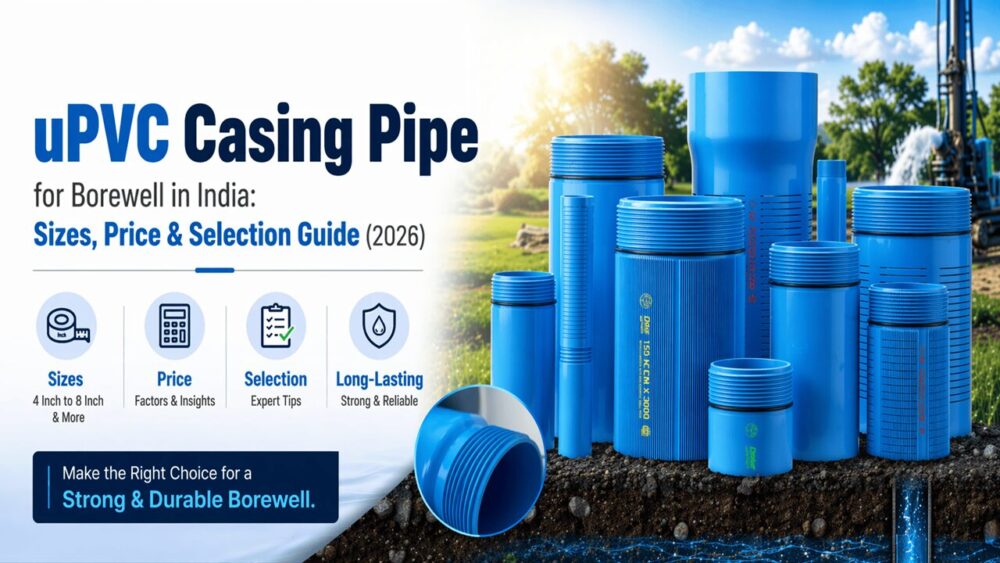
Best uPVC Casing Pipe for Borewell in India: Size, Series & Buying Guide
Choosing a casing pipe is not simply a matter of buying the largest pipe or selecting the lowest quotation. The casing has to match the drilled bore, depth, ground conditions and complete borewell design.
For many borewell applications in India, a properly selected uPVC casing pipe is a practical option because it is corrosion-resistant, lightweight and available in different sizes and strength series. However, there is no single casing size or series that is best for every borewell. Bore depth, drilled diameter, geological conditions, pump size, screen requirement and actual pipe dimensions should all be checked before installation.
If you are comparing options, start by reviewing the Duke uPVC casing pipe range and then match the specifications to your borewell conditions.
What Is a uPVC Casing Pipe?
A uPVC casing pipe is installed inside a drilled borewell to help maintain the structure of the bore and protect it from unstable surrounding formations.
Depending on the well design, casing can help:
- support the drilled bore
- reduce the entry of loose soil and unwanted material
- provide a stable passage inside the borewell
- support plain and screen sections in the well assembly
- protect the bore before the pumping system is installed
uPVC does not rust like conventional metal piping, which is one reason it is widely considered for underground borewell applications.
For bore/tubewell applications, IS 12818:2010 is the relevant Bureau of Indian Standards specification for unplasticized PVC screen and casing pipes.
Which Casing Pipe Is Best for a Borewell?
For many Indian borewell projects, uPVC casing pipe is a strong practical choice, but the correct specification matters more than simply choosing uPVC.
The best casing pipe is one that matches:
- borewell depth
- drilled bore diameter
- ground formation
- required casing diameter
- plain or screen requirement
- pump dimensions
- installation conditions
- required pipe series
- manufacturer’s technical specifications
A pipe that works well in one borewell may not be appropriate for another.
Instead of asking only, “Which casing pipe is best?”, a better question is:
“Which casing size and series is suitable for my borewell conditions?”
That question leads to a much safer and more useful buying decision.
Casing Pipe vs Column Pipe: What Is the Difference?
Casing and column pipes are both used around borewell systems, but they perform completely different jobs.
| Pipe Type | Main Function |
|---|---|
| Casing Pipe | Supports and protects the drilled bore |
| Column Pipe | Carries pumped water from the submersible pump toward the surface |
A simple way to remember it is:
Casing pipe = bore protection
Column pipe = pumped water delivery
If you are also selecting piping for the submersible pump, see the Duke uPVC column pipe range.
Why Is uPVC Commonly Used for Borewell Casing?
uPVC offers several practical characteristics for suitable borewell installations.
Corrosion Resistance
Unlike conventional metal pipes, uPVC does not rust. This is useful in underground applications where the pipe can remain exposed to water and soil conditions for long periods.
Lightweight Handling
uPVC casing is lighter than many traditional metal alternatives, making transportation and handling at a borewell site easier.
Smooth Internal Surface
Its smooth internal surface provides a clean passage through the casing and avoids the conventional rusting associated with metal surfaces.
Different Sizes and Series
uPVC casing systems are available in multiple diameters and strength categories, allowing selection according to the specific borewell design.
Easier Installation
Threaded casing systems can simplify joining and lowering when the correct installation procedure and pipe specifications are followed.
How Do You Choose the Right Borewell Casing Pipe Size?
There is no reliable rule such as:
4 inch = home
6 inch = agriculture
8 inch = industry
Borewell casing size should be selected from the actual technical requirements of the well.
Check these factors first:
- Drilled bore diameter
- Actual casing outside diameter
- Maximum diameter over the pipe connection
- Borewell depth
- Pump dimensions
- Geological formation
- Plain or screen section requirement
- Gravel-pack or annular-clearance requirement, where applicable
- Installation method
For a broader explanation of the complete system, read the Duke Borewell Pipe Guide.
Nominal Pipe Size Is Not the Same as Actual Outside Diameter
This is an important detail that buyers often miss.
A pipe commonly described as a “6-inch casing pipe” does not necessarily have an outside diameter of exactly 6 inches.
For example, Duke’s current technical data lists its 150 mm nominal casing pipe with a mean outside diameter of approximately 165 mm. The maximum diameter over the threaded connection is larger again and varies by series.
This is why borewell planning should use actual technical dimensions rather than relying only on the common inch description.
Can 6-Inch Casing Be Used in an 8-Inch Borewell?
A 6-inch nominal casing may be used inside an 8-inch drilled bore in some designs, but “8-inch borewell = 6-inch casing” is not a universal rule.
An 8-inch bore is approximately 203 mm in drilled diameter. Duke’s 150 mm nominal casing, for example, has an actual outside diameter of around 165 mm, while the connection diameter is larger.
That does not automatically mean the combination is suitable.
The installer still needs to check:
- connection clearance
- geological formation
- gravel-pack requirement
- screen configuration
- pump dimensions
- bore straightness
- installation method
So if you are planning an 8-inch borewell with 6-inch casing, confirm the actual OD and joint dimensions before ordering.
CS vs CM vs CD Casing Pipe: Which Series Do You Need?
Duke currently offers uPVC casing pipes in CS, CM and CD series for different borewell depth requirements.
| Duke Series | Current Listed Application Depth |
| CS Series | Up to 80 m |
| CM Series | Up to 150 m |
| CD Series | Up to 450 m |
These are Duke’s current listed product specifications and should not be treated as universal specifications for every casing brand.
CS Series
CS casing is intended for shallower borewell requirements within the manufacturer’s specified limits.
CM Series
CM provides a heavier option for applications requiring greater installation depth.
CD Series
CD is intended for deeper and more demanding borewell applications according to Duke’s current technical range.
Do not select CS, CM or CD only by price.
Bore depth is important, but soil conditions, casing diameter, wall thickness, connection design and installation conditions should also be considered.
For exact diameter and wall-thickness tables, use the Duke Pipes technical brochure and download resources.
Plain Casing Pipe vs Screen Pipe
Another important decision is whether the bore requires plain casing, screen pipe or a combination of both.
Plain Casing Pipe
Plain casing is generally used where the bore structure needs support but groundwater entry through the pipe wall is not required at that section.
Screen Pipe
Screen or slotted pipe allows groundwater to enter the well through designed openings while helping restrict larger formation material.
The position and type of screen should match the water-bearing formation identified during drilling.
Installing screen sections simply at a fixed depth without considering geological conditions can reduce the effectiveness of the completed borewell.
uPVC vs GI Pipe for Borewell Casing
There is no need to label one material as universally “best.” Their characteristics are different.
| Feature | uPVC Casing | Conventional GI/Metal Casing |
| Rust | Does not rust | May corrode |
| Weight | Lightweight | Heavier |
| Handling | Easier | More labour-intensive |
| Internal surface | Smooth | Can be affected by corrosion or deposits |
| Series selection | Available in different specifications | Depends on metal grade and design |
| Underground use | Common in suitable borewell applications | Also used depending on project conditions |
For many borewell applications, uPVC provides advantages in corrosion resistance and handling.
The final choice should still consider depth, geology, mechanical requirements and installation conditions.
What Is the uPVC Casing Pipe Price in India?
There is no single fixed uPVC casing pipe price because buyers are not purchasing only a pipe length.
Price can change according to:
- nominal diameter
- actual pipe specification
- CS, CM or CD series
- wall thickness
- plain or screen design
- pipe length
- order quantity
- delivery location
- transportation
- current commercial pricing
This is why two pipes both described as “6-inch casing” can have different prices.
What Is Duke Borewell Pipe Price for 10 Feet?
“Duke borewell pipe price 10 feet” is a common buying query, but length alone is not enough to give an accurate quotation.
For current pricing, provide:
1. Required diameter
Example: 4 inch, 6 inch, 8 inch, etc.
2. Required series
CS, CM or CD.
3. Pipe type
Plain casing or screen pipe.
4. Quantity
Number of pipes required.
5. Delivery location
Transportation can affect the final quotation.
For current availability and project-specific pricing, request a casing pipe quotation from Duke Pipes.
7 Checks Before Buying a Borewell Casing Pipe
Before placing an order, use this quick checklist.
1. Confirm Borewell Depth
Do not select the series until the expected bore depth is known.
2. Confirm the Drilled Diameter
The drilled bore must provide suitable space for the actual casing and its joints.
3. Check Actual Pipe OD
Do not assume nominal inch size equals actual outside diameter.
4. Understand the Ground Formation
Loose formations, sand and hard-rock sections can require different well designs.
5. Check Plain and Screen Requirements
The complete installation may require different pipe sections at different depths.
6. Review Technical Specifications
Check diameter, wall thickness, connection size, threading and applicable product standards.
7. Get Professional Installation Guidance
A general online guide cannot replace the borewell contractor’s site-specific assessment.
Common Borewell Casing Pipe Mistakes to Avoid
A borewell project involves drilling, labour, pumping equipment and installation costs. A poor casing decision can make later corrections difficult.
Avoid these common mistakes:
- selecting a pipe only because it is cheaper
- choosing the casing before confirming bore diameter
- using the wrong CS, CM or CD series
- ignoring actual outside diameter
- forgetting the larger diameter of the threaded connection
- ignoring geological conditions
- planning screen positions without formation information
- using damaged threads
- forcing casing into an obstructed bore
- buying without reviewing technical specifications
The aim is not simply to install a pipe. The pipe needs to work correctly as part of the complete borewell design.
Basic Borewell Casing Installation Process
Actual borewell installation should be performed by experienced professionals, but a typical process may include:
- Drill the bore to the planned depth and diameter.
- Record the formations encountered during drilling.
- Determine the required plain and screen sections.
- Select the appropriate casing size and series.
- Lower the first casing section carefully.
- Join subsequent pipes using the manufacturer’s recommended threading method.
- Maintain alignment while lowering the casing.
- Install screen sections in the required water-bearing zones.
- Complete the remaining borewell and pumping arrangement.
Never force a casing pipe merely to move past an obstruction.
If actual drilling conditions differ significantly from the original plan, the borewell design should be reviewed before continuing.
Why Consider Duke uPVC Casing Pipes?
Duke Pipes manufactures uPVC casing systems for borewell and related applications from Gujarat, India.
Its current casing range includes:
- CS, CM and CD series
- multiple nominal diameters
- plain and screen options
- detailed outside-diameter and wall-thickness specifications
- threaded socket-and-spigot joining
- casing products listed against IS 12818:2010 specifications
Duke’s current product information also states that the company has been manufacturing since 1998 and received a National Quality Award in 2007.
The important point is still to select the product by project requirement, not by brand name alone.
Which Casing Pipe Should You Finally Choose?
For many Indian borewell projects, uPVC casing is a practical option because it combines corrosion resistance, easier handling and multiple size and series choices.
But the best casing pipe for a borewell is not simply the strongest or most expensive pipe.
It is the casing that correctly matches:
- bore depth
- drilled diameter
- actual pipe OD
- ground conditions
- screen design
- pump requirements
- appropriate series
- professional installation plan
If these details are clear before buying, comparing product options and quotations becomes much easier.
Frequently Asked Questions
1. What is the best casing pipe for a borewell?
For many borewell applications in India, uPVC casing is a practical option because it does not rust, is comparatively lightweight and is available in different sizes and series. The correct casing should still be selected according to bore depth, drilled diameter, geology and well design.
2. Which size casing pipe is best for a borewell?
There is no single best size. The correct casing diameter depends on drilled bore diameter, actual pipe outside diameter, connection size, pump dimensions, geological conditions and any screen or gravel-pack requirements.
3. Can I use 6-inch casing in an 8-inch borewell?
It may be possible in some installations, but it is not a universal rule. Actual casing OD, threaded connection diameter, required clearance, screen design and geological conditions should be checked before installation.
4. What is the difference between CS, CM and CD casing pipes?
For Duke’s current uPVC casing range, CS is listed for installations up to 80 m, CM up to 150 m and CD up to 450 m. Always use the manufacturer’s current specifications rather than applying these figures to every brand.
5. What is uPVC casing pipe price in India?
Price varies according to casing diameter, series, wall thickness, plain or screen design, quantity, transportation and delivery location. Current pricing should therefore be requested using the exact project specifications.
6. What is Duke casing pipe price for 10 feet?
The exact price cannot be determined from length alone. You should provide the required diameter, CS/CM/CD series, plain or screen requirement, quantity and delivery location to receive a relevant quotation.
7. Is uPVC better than GI for borewell casing?
uPVC offers advantages such as corrosion resistance, lighter weight and easier handling. GI and other metal casing systems have different mechanical characteristics. The better option depends on bore depth, ground conditions and the complete well design.
Need Help Choosing the Right Borewell Casing Pipe?
Before requesting a quotation, keep these details ready:
- borewell depth
- drilled bore diameter
- required casing diameter
- ground or geological conditions
- plain or screen requirement
- approximate quantity
- project delivery location
Then contact Duke Pipes for product selection and current casing pipe pricing.
Choose the casing specification for the borewell first. Compare the price second.
Written by: Duke Pipes Technical Content Team
Last Updated: August 27, 2026