PVC Pipe Joint Types: Types, Uses & Connection Guide
PVC pipes can be joined using different methods depending on the pipe system, application, pressure and installation requirements. Common methods relevant to rigid PVC-U or uPVC systems include solvent cement joints, elastomeric sealing-ring or rubber-ring joints, and specially designed threaded connections. The correct joint depends on pipe type, diameter, service conditions and manufacturer specifications.
What Is a PVC Pipe Joint?
A PVC pipe joint is the connection formed between a pipe and another pipe, fitting or compatible piping component. Its purpose is to create a continuous piping system while maintaining alignment, flow and, where required, a watertight or pressure-resistant connection.
PVC pipe joints are necessary because a piping network is assembled from individual pipe lengths, bends, tees, couplers and other components. The joining method depends on the pipe design, application, diameter and operating conditions.
In India, the term “PVC pipe” is also commonly used when discussing rigid PVC-U or uPVC piping systems. This guide primarily focuses on uPVC connection methods relevant to Duke’s uPVC pipes and piping systems.
What Are the Different Types of PVC Pipe Joints?
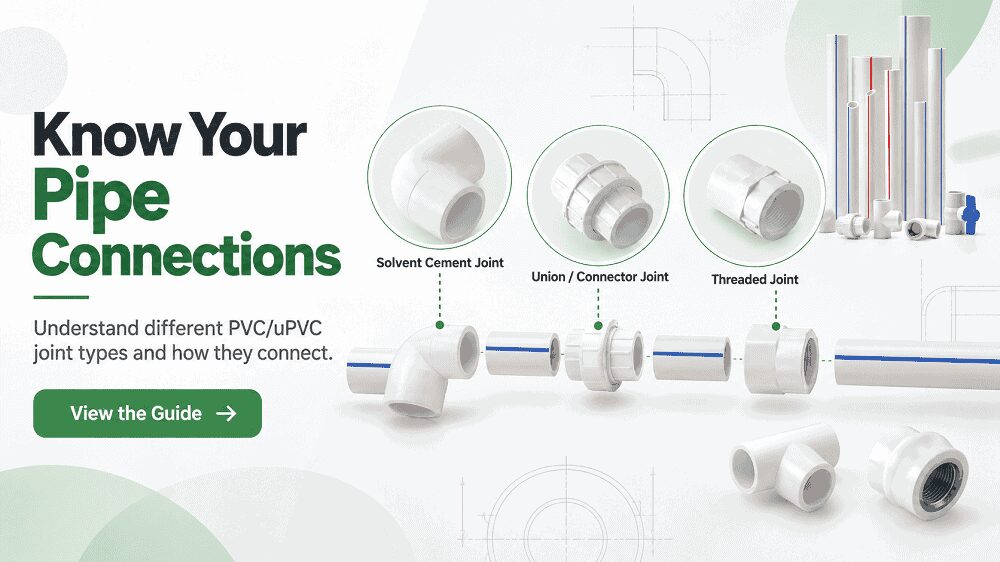
The main PVC joint types relevant to the uPVC systems covered in this guide are solvent cement joints, elastomeric sealing-ring joints and designed threaded connections. They work differently and are selected according to the pipe system rather than interchangeably.
BIS documentation for IS 4985:2021 recognizes both sockets for solvent-cement jointing and sockets for elastomeric sealing-ring jointing in unplasticized PVC water-supply pipes.
Solvent Cement Joint
A solvent cement joint connects compatible PVC or uPVC pipe and socket fittings using a suitable solvent cement. The joining compound acts on the mating PVC surfaces so that, when correctly assembled and cured, they form a permanent connection.
This method is commonly used in compatible plumbing, water-supply and drainage piping where the pipe and fitting have been designed for solvent-weld jointing.
Duke’s uPVC SWR Pipe and fittings range, for example, includes fittings available in solvent-weld as well as self-fit ring versions.
A solvent cement joint is generally considered permanent. If a joined section has to be replaced, cutting and replacing the affected pipe or fitting is normally required.
For reliable jointing, installers should use compatible pipes, fittings and solvent cement, prepare the pipe end properly and follow the specified assembly and curing instructions. BIS IS 14182 covers solvent cement for use with unplasticized PVC pipes and fittings.
Elastomeric Sealing-Ring or Rubber-Ring Joint
An elastomeric sealing-ring joint connects a pipe spigot to a specially designed socket containing a flexible sealing ring. When the spigot is inserted correctly, the elastomeric ring forms the seal between the components.
Depending on the product and manufacturer terminology, this connection may also be described as a rubber-ring, ring-fit, push-fit or self-fit joint. These terms should not automatically be treated as identical across every PVC system; the manufacturer’s specification should be followed.
Duke’s uPVC Pressure Pipe range uses elastomeric sealing rings and is intended for applications including agriculture, irrigation and water distribution.
Duke’s uPVC UDS Pipe system also uses an elastomeric rubber-ring sealing arrangement for underground drainage applications.
Important installation factors include clean pipe ends, an undamaged and correctly positioned seal, proper alignment, specified insertion depth and the recommended lubricant where applicable.
Threaded Joint for Specific PVC/uPVC Systems
A threaded PVC joint connects components using compatible male and female threads. Unlike a solvent-weld joint, a connection specifically designed for threaded assembly may allow disconnection or component replacement.
However, threaded connections should only be used where the pipe or fitting has been designed for them. A standard solvent-weld or ring-fit pipe should not be assumed to be suitable for field threading.
Duke uses threaded connections in specific product systems. Its ASTM Plumbing Pipe range includes special BSP-thread compatibility for connection with GI fittings.
Duke’s uPVC Column Pipe uses specially designed internal and external square-threaded ends along with sealing-ring arrangements for borewell and submersible-pump applications.
These examples show why “threaded joint” should be treated as a system-specific connection, not as a universal joining method for every PVC pipe.
Technical note: Other connection arrangements may exist in broader PVC piping systems. They should only be specified for Duke products where the particular connection is supported by the relevant product design and Duke’s technical guidance.
PVC Pipe Joint Types Chart
| PVC Joint Type | How It Connects | Typical Application | Permanent / Removable | Key Consideration |
|---|---|---|---|---|
| Solvent cement joint | Compatible pipe and socket joined using solvent cement | Plumbing, water supply, drainage | Permanent | Surface preparation and curing |
| Elastomeric sealing-ring joint | Spigot inserted into socket containing flexible sealing ring | Water supply, irrigation, drainage | System-dependent; not normally a service disconnect | Seal condition, alignment and insertion |
| Threaded joint | Compatible male and female threads connect components | Selected plumbing and column-pipe systems | Removable where designed for disassembly | Correct thread design and compatibility |
This chart is a general comparison. The appropriate joint should always be confirmed against the pipe series, application and manufacturer’s installation requirements.
What Is the Difference Between a PVC Joint, Fitting and Connector?
A PVC joint is the completed connection between components. A PVC fitting is a purpose-built component used to connect, redirect, branch, reduce, terminate or transition a piping system. A PVC connector is a broader term commonly used for components that connect pipes or other piping parts.
| Term | Meaning | Example Purpose |
|---|---|---|
| Joint | Connection formed between components | Joining two pipe sections |
| Fitting | Purpose-built piping component | Changing direction or creating a branch |
| Connector | General connecting component or term | Connecting pipes or other system parts |
For example, a coupling is a PVC pipe fitting or connector. Once the pipe and coupling are correctly assembled, the connection between them becomes the PVC joint.
This distinction helps when comparing terms such as PVC pipe connectors, PVC connectors, PVC pipe fittings and PVC joints, which are related but do not necessarily describe the same thing.
What Is a PVC Pipe Coupling?
A PVC pipe coupling is a fitting used primarily to connect compatible pipe sections. The coupling provides the physical connection point, while the completed connection between the coupling and pipe forms the joint.
The coupling must match the pipe’s size, end design and intended joining method. It should not be selected only because two pipes have a similar nominal diameter.
What Are the Different PVC Coupling Types?
In the context of the systems discussed here, PVC coupling types may include solvent-weld couplings, self-fit or ring-seal couplings and specially designed threaded couplers.
For example, Duke’s SWR product range includes couplers within a fitting system available in self-fit ring and solvent-weld versions, while Duke’s column-pipe system uses purpose-designed threaded couplers for connecting pipe sections.
Therefore, when selecting PVC pipe coupling types, the connection method should be matched to the actual piping system rather than treating all couplings as interchangeable.
How Do You Choose the Right PVC Pipe Joint?
The correct PVC pipe connection type depends on the complete piping system, not simply on which joint appears easiest to install.
Consider these factors:
- Application: Plumbing, water supply, agriculture, irrigation, drainage and borewell systems have different requirements.
- Pipe system: Identify whether the pipe is pressure pipe, SWR, underground drainage, ASTM plumbing, column pipe or another system.
- Diameter: Joint dimensions and fitting availability must match the actual pipe size.
- Pressure requirements: Pressure pipelines require connections designed and rated for the intended service conditions.
- Operating environment: Temperature, external loading, underground installation and movement can influence joint selection.
- Permanent vs removable connection: Solvent-welded connections serve a different maintenance requirement from purpose-designed threaded connections.
- Access for maintenance: Equipment connections may require a system designed for future servicing.
- Compatible components: Pipe, fitting, seal, solvent and connector should belong to a compatible system.
- Manufacturer guidance: Follow the latest jointing and installation recommendations for the actual product.
- Applicable standards: Check relevant product standards and project specifications before installation.
There is no single PVC joint type that is automatically the best for every application.
How Are PVC Pipes Joined?
PVC pipes are joined by preparing compatible pipe ends and fittings and applying the connection method specified for that system. Depending on the product, this may involve solvent cement, an elastomeric sealing ring or a specially designed threaded connection.
A general joining process is:
- Identify the pipe and joint system. Check material, size, application and compatible fittings.
- Inspect the components. Pipe ends, sockets, seals and threads should be clean and free from visible damage.
- Prepare the pipe end. Cutting, deburring, chamfering, cleaning or other preparation depends on the connection type.
- Prepare the joint. Apply compatible solvent cement, position the sealing ring or prepare designed threads according to the specified system.
- Assemble correctly. Maintain proper alignment and insertion or tightening requirements.
- Allow curing where required. Solvent-cement joints require the specified setting or curing period before service.
- Inspect and test. Check the completed joint and carry out any required pressure, leakage or installation testing.
There should not be one universal “PVC pipe joining procedure” because solvent-weld, elastomeric-ring and threaded systems rely on different connection principles.
Common PVC Pipe Jointing Mistakes to Avoid
Common jointing problems often result from incompatible components or incorrect installation rather than the pipe material itself.
Avoid using mismatched pipe and fittings, selecting the wrong diameter, working with damaged sealing surfaces, ignoring pipe-end preparation, incorrectly positioning rubber rings, using unsuitable solvent cement, forcing misaligned components, cross-threading designed threaded connections or putting solvent-welded piping into service before the required curing period.
Another common mistake is assuming that the same jointing procedure applies to every PVC pipe.
Always check the manufacturer’s current technical instructions for the specific pipe and fitting system before installation.
Where Are Different PVC Pipe Connections Used?
Different PVC pipe connectors and plumbing connections are used according to the application and piping system.
Plumbing: Specially designed threaded and compatible socket connections may be used in plumbing systems. Duke’s ASTM Plumbing Pipe range includes BSP-thread compatibility with GI fittings and is intended for residential, commercial and industrial plumbing applications.
Water supply and irrigation: Pressure-water systems may use elastomeric sealing-ring or solvent-cement sockets depending on the product design. IS 4985:2021 recognizes both end types, while Duke’s current uPVC Pressure Pipe range specifically uses elastomeric sealing rings.
Soil, waste and rainwater drainage: Both self-fit ring and solvent-weld fittings are available within Duke’s uPVC SWR system. This allows the connection method to follow the selected SWR pipe and fitting configuration.
Underground drainage: Duke’s uPVC UDS system uses an elastomeric rubber-ring sealing system for applications such as underground sewage and stormwater drainage.
Borewell and submersible applications: Duke’s uPVC Column Pipes use specially designed square-threaded ends, sealing rings and couplers rather than an ordinary plumbing-pipe connection.
Choosing PVC Pipes and Fittings for Your Application
Selecting a PVC or uPVC pipe should involve the complete piping system: pipe type, size, operating pressure, fittings, jointing method, installation environment and maintenance requirements.
Duke manufactures different uPVC systems for plumbing, pressure-water distribution, SWR drainage, underground drainage, borewell and other applications. Because the connection design differs between these systems, the pipe and jointing method should be selected together rather than independently. Explore Duke’s uPVC pipe product range to compare products by application.
For project-specific installation, verify the latest technical specifications and recommended jointing procedure before installation.
Frequently Asked Questions
1. What are the different types of PVC pipe joints?
Common joint types relevant to rigid PVC-U or uPVC piping include solvent cement joints, elastomeric sealing-ring or rubber-ring joints, and designed threaded connections. The appropriate method depends on the pipe system, size, pressure, application and manufacturer’s specifications.
2. Which joint is commonly used to connect PVC pipes?
There is no single connection suitable for every PVC pipe. Solvent cement is common in compatible socket systems, while elastomeric sealing-ring joints are used in specific pressure and drainage systems. Special threaded connections are used only where the pipe or fitting has been designed for them.
3. What is a PVC pipe connector?
A PVC pipe connector is a general term for a component used to connect a pipe to another pipe, fitting or system component. Couplings and adapters are examples, but their connection design must match the pipe system.
4. What is the difference between a PVC joint and a PVC fitting?
A PVC fitting is a physical component used to connect, redirect, branch or transition piping. A PVC joint is the connection created when the pipe and another compatible component are assembled.
5. Is a PVC coupling the same as a pipe joint?
No. A PVC coupling is a fitting used to connect compatible pipe sections. The assembled connection between the coupling and the pipes is the joint.
6. Can PVC pipe joints be disconnected?
It depends on the joint design. Solvent-cement joints are normally permanent. Purpose-designed threaded connections may be disconnected where the system permits. Elastomeric-ring joints should be handled according to the manufacturer’s installation and maintenance guidance.
7. How do I choose the right PVC pipe connector?
Match the connector to the pipe material, outside diameter, fitting system, pressure requirement, application and specified connection method. Do not select a connector based on nominal pipe size alone.
8. Does PVC joint type depend on pipe size?
Yes. Pipe diameter can affect socket dimensions, fitting availability, sealing components and installation requirements. The size should be checked together with the pipe series and specified connection system.
9. Which PVC joint is suitable for water pipes?
The correct joint depends on the specific water-supply pipe. IS 4985:2021 recognizes both solvent-cement and elastomeric sealing-ring socket configurations for applicable PVC-U water-supply pipes. The final connection should follow the actual pipe design and manufacturer instructions.