CPVC vs UPVC Pipe: Complete Comparison Guide [2026]
Choosing the wrong pipe can lead to leakage, pressure failure, and costly repairs.
Many people get confused between CPVC vs uPVC pipes because they look similar. But in reality, they are built for completely different applications.
If you are planning a borewell, irrigation system, plumbing setup, or construction project, selecting the right pipe is critical.
In this guide, you will learn:
- The real difference between CPVC and uPVC pipes
- Which pipe is better for your use
- Price, strength, and lifespan comparison
- Expert recommendations based on real-world applications
What is the Difference Between CPVC and uPVC Pipes?
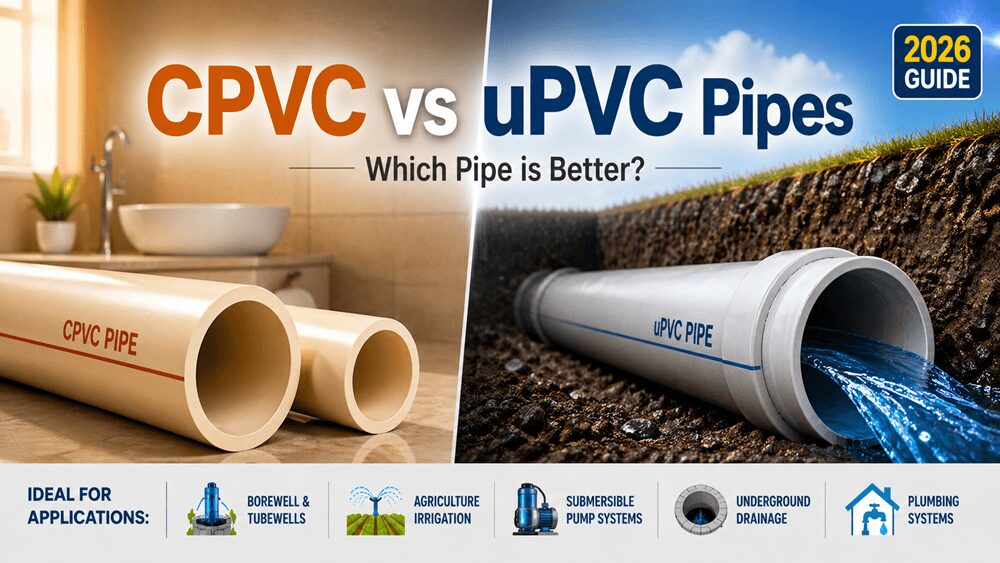
The main difference between CPVC vs uPVC pipes is that CPVC is designed for hot water applications, while uPVC is used for high-pressure, underground, and cold water systems.
uPVC pipes are stronger, more durable, and more cost-effective for most applications, while CPVC is only suitable for high-temperature plumbing.
For most real-world uses, uPVC is the better choice.
CPVC vs uPVC Pipes – Detailed Comparison Table
| Feature | uPVC Pipe | CPVC Pipe |
|---|---|---|
| Temperature Resistance | Low | High |
| Pressure Strength | High | Medium |
| Lifespan | Long | Medium |
| Cost | Affordable | Expensive |
| Best Use | Borewell, irrigation, underground | Hot water plumbing |
CPVC handles heat, uPVC handles pressure and durability.
What is uPVC Pipe?
uPVC (Unplasticized Polyvinyl Chloride) is a rigid, high-strength pipe widely used in borewell, agriculture, underground pipelines, and industrial water systems.
It does not contain plasticizers, making it stronger, corrosion-resistant, and long-lasting.
High-quality uPVC pipes are manufactured as per IS 12818:2010 (DIN 4925 equivalent) and are designed for demanding conditions.
Key Features:
- High pressure handling
- Corrosion and chemical resistant
- Suitable for underground installation
- Long service life
- Low maintenance
For example, modern uPVC casing pipes can support depths up to 450 meters (CD Series), making them ideal for deep borewell systems.
In short: uPVC is built for strength, depth, and durability.
What is CPVC Pipe?
CPVC (Chlorinated Polyvinyl Chloride) is a modified plastic pipe designed for high-temperature water flow.
It is mainly used in:
- Bathrooms
- Kitchens
- Hospitals
- Indoor plumbing systems
Key Features:
- Heat resistant
- Suitable for hot water
- Chemical resistant
However, CPVC pipes are more expensive and not suitable for high-pressure or deep underground use.
CPVC is best for hot water applications only.
Difference Between CPVC and uPVC Pipes (Detailed Comparison)
Strength & Pressure Handling
uPVC pipes are engineered for high-pressure environments like borewells and irrigation systems.
They can handle heavy soil load and deep water pressure without failure.
For high-pressure applications, specially designed pressure pipes are recommended.
Temperature Resistance
CPVC pipes can withstand hot water, making them ideal for indoor plumbing. In short: Use CPVC only for heat applications.
Cost Difference
CPVC pipes are more expensive due to heat-resistant properties.
uPVC pipes are more affordable and widely used in large-scale applications. In short: uPVC offers better cost efficiency.
Lifespan & Durability
uPVC pipes offer long-lasting performance in outdoor and underground conditions.
They resist corrosion, chemicals, and environmental damage. In short: uPVC lasts longer in real-world conditions.
Maintenance
uPVC pipes require minimal maintenance due to strong joints and durable material. In short: Less maintenance, more savings.
Advanced Technical Comparison (Expert Insight)
This is where most blogs fail—but real decision happens here:
- uPVC casing pipes support up to 450m depth, far beyond typical CPVC usage
- Multiple series (CD, CM, CS, RMS, RDS, PMS, PDS) allow precise application selection
- Column pipes use square thread technology, providing stronger grip than standard round threads
- Water flow efficiency: 10–30% more flow
- Energy saving: 10–20% lower power consumption
In short: uPVC is engineered for performance, not just basic use.
Use Case Guide: Which Pipe Should You Choose?
Borewell & Tube Well
Use borewell casing pipes for deep installations.
- Supports deep installations up to 450m
- High soil pressure resistance
In short: Borewell = uPVC only.
Agriculture Irrigation
Use uPVC pressure pipes or HDPE pipes.
- UV stabilized
- Durable in outdoor conditions
In short: uPVC is best for farming.
Submersible Pump Systems
Use uPVC column pipes for submersible pump systems.
- Square thread = better grip
- Leak-proof joints
- Higher water flow
In short: Better design = better efficiency.
Underground Drainage
Use uPVC UDS pipes for underground drainage systems.
In short: Underground = uPVC strength.
Home Plumbing (Hot Water)
Use CPVC pipes.
In short: CPVC only for hot water.
Why Professionals Prefer uPVC Pipes
Borewell contractors, engineers, and farmers across India prefer uPVC because:
- Handles high pressure and depth
- Reliable for long-term use
- Cost-effective
- Low maintenance
Companies like Duke Pipes (Gujarat), with 25+ years of experience, supply across 20+ states and 30+ countries, trusted by thousands of contractors and distributors.
In short: Professionals trust uPVC for performance.
Buyer Decision Checklist
Before choosing a pipe, ask:
- What is the pressure requirement?
- Is it underground or indoor?
- Will hot water flow?
- What is the required lifespan?
- What is your budget?
In short: Match the pipe to the application.
Final Decision: CPVC vs uPVC Pipes – Which is Better?
- Borewell / irrigation / underground → uPVC
- Long-term durability → uPVC
- Budget-friendly projects → uPVC
- Hot water plumbing → CPVC
In short: For most applications, uPVC is the smarter and safer choice.
Real-World Quality & Certifications
High-quality pipes are manufactured using:
- Fully automatic testing labs
- SPC & SQC quality control
- CAD-CAM based R&D
- Certifications: ISI, BIS, ISO 9001:2015, ISO 14001:2015, ZED Gold
Trusted manufacturers like Duke Pipes have:
- 270+ distributors
- 3500+ dealers
- Presence across India and exports to multiple countries
In short: Certified quality ensures long-term reliability.
CPVC vs uPVC Price Difference
- CPVC → higher initial cost
- uPVC → affordable
But real value:
- uPVC = long life + low maintenance
- CPVC = limited use
In short: uPVC is more cost-effective over time.
FAQs
Which is better: CPVC or uPVC?
For most uses like borewell and irrigation, uPVC is better. CPVC is used only for hot water.
Can uPVC pipes handle high pressure?
Yes, uPVC pipes are designed for high-pressure and deep installations.
What is the difference between CPVC and uPVC pipes?
CPVC is used for hot water, while uPVC is used for pressure and underground systems.
Which pipe lasts longer?
uPVC pipes generally last longer in real-world conditions.
Conclusion
Both CPVC and uPVC pipes have their own uses, but they are not interchangeable.
- CPVC → hot water systems
- uPVC → high pressure, underground, irrigation
If you want durability, strength, and cost efficiency, uPVC is the better choice in most cases.
Need Help Choosing the Right Pipe?
Duke Pipes manufactures high-quality UPVC piping solutions for borewell, irrigation, drainage, and plumbing applications across India.
- ISI Certified
- 25+ Years Experience
- Trusted by Dealers & Contractors
👉 Contact Duke Pipes Experts Today