UPVC Full Form: What It Means and Where UPVC Pipes Are Used
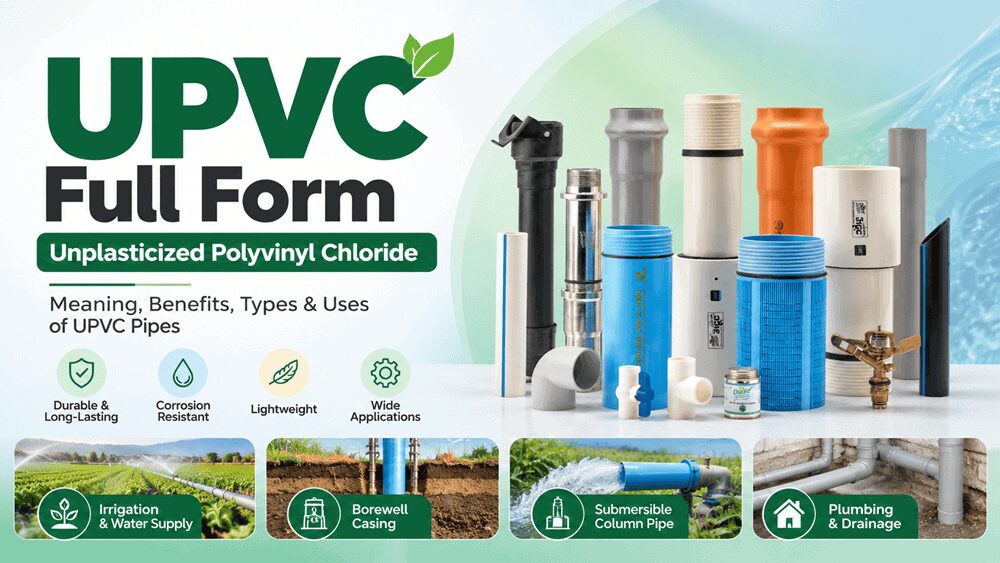
UPVC stands for Unplasticized Polyvinyl Chloride. It is a rigid form of PVC commonly used to manufacture pipes and fittings for applications such as water supply, irrigation, borewells, plumbing and drainage.
But knowing the UPVC full form is only the beginning. A pressure pipe, casing pipe, column pipe and drainage pipe may all belong to the UPVC family, yet each is designed for a different job.
This guide explains what UPVC means, how the material is used in piping systems, the main types of UPVC pipes and what you should check before choosing one for your project.
What Is the Full Form of UPVC?
The full form of UPVC is Unplasticized Polyvinyl Chloride.
The abbreviation can be broken down as:
- U – Unplasticized
- PVC – Polyvinyl Chloride
The word unplasticized means the material is not made flexible by adding plasticizers for that purpose. This helps UPVC retain a rigid structure, which is why it is widely used for rigid piping and construction applications.
You may also see terms such as uPVC, UPVC and PVC-U used in the context of rigid unplasticized PVC.
UPVC at a Glance
| Question | Simple Answer |
|---|---|
| What is the full form of UPVC? | Unplasticized Polyvinyl Chloride |
| What does the “U” mean? | Unplasticized |
| Is UPVC rigid? | Yes, it is a rigid PVC material |
| Is UPVC used only for plumbing? | No |
| Where is UPVC commonly used? | Water supply, irrigation, borewells, plumbing and drainage |
| Are all UPVC pipes the same? | No. Different pipes are designed for different applications |
What Is UPVC Material?
UPVC is a rigid material from the PVC family that is formulated without plasticizers added to make it flexible.
This distinction is important because PVC is a broad material family. Different PVC formulations may be designed for flexible or rigid applications.
For piping systems, UPVC offers characteristics that can make it useful for many applications, including:
- resistance to corrosion,
- rigid construction,
- relatively low weight,
- smooth internal surfaces,
- resistance to many commonly encountered chemicals, and
- suitability for different water and drainage systems when the correct product is selected.
“Unplasticized” does not mean that the material contains no other ingredients. Pipe compounds may include additives needed for processing, stability, colour or product performance.
The exact formulation, dimensions and performance requirements depend on the type of pipe being manufactured.
What Is a UPVC Pipe?
A UPVC pipe is a rigid PVC pipe manufactured for a defined piping application such as pressure water supply, borewell systems, plumbing or drainage.
One of the most important things to understand is that UPVC describes the material family; it does not tell you the complete application of the pipe.
For example:
- a pressure pipe carries pressurized water,
- a casing pipe performs a borewell casing function,
- a column pipe works with a submersible pump, and
- an SWR pipe is used for soil, waste and rainwater drainage.
So, choosing a pipe only because it is labelled “UPVC” is not enough.
You should also consider:
- application,
- pipe diameter,
- operating pressure,
- fluid temperature,
- installation conditions,
- jointing method, and
- applicable product specification.
Where Are UPVC Pipes Used?
UPVC piping systems are used across agricultural, residential, commercial, borewell and drainage applications. The correct system depends on what the pipe needs to do.
Water Supply and Irrigation
Pressure-rated UPVC pipes can be used where water needs to move through a pressurized piping system.
Common applications can include:
- agricultural irrigation,
- water distribution, and
- other suitable pressure-water systems.
Duke’s current uPVC Pressure Pipe range includes different pressure classes under IS 4985:2021, depending on pipe size and specification.
For application-specific details, explore the Duke uPVC Pressure Pipe range.
Borewell Casing
A casing pipe is used as part of a borewell structure.
Its purpose is different from the pipe used to lift water from the borewell, which means the two should not be selected interchangeably.
Borewell casing selection may depend on factors such as:
- bore depth,
- diameter,
- ground conditions,
- casing series,
- wall thickness, and
- installation conditions.
Duke’s own casing-pipe guidance also notes that diameter and price alone are not enough for correct selection.
Explore the Duke uPVC Casing Pipe range.
Submersible Pump Systems
A column pipe is used with a submersible pumping system to carry water upward from the pump.
This is different from borewell casing.
If you are selecting a pipe for a submersible installation, consider the actual pumping requirement, installation depth and manufacturer’s product specifications rather than treating an ordinary UPVC pipe as a replacement.
Explore Duke uPVC Column Pipes.
Soil, Waste and Rainwater Drainage
SWR stands for Soil, Waste and Rainwater.
These pipes are designed for building drainage rather than for the same job as a pressure-water pipe.
Duke’s current SWR technical information lists its SWR system under IS 13592:2013.
For drainage applications, see the Duke uPVC SWR Pipe range.
Underground Drainage
Underground drainage requires a piping system intended for buried drainage conditions.
Duke lists a separate uPVC UDS Pipe system within its current uPVC product portfolio, alongside pressure, casing, column, SWR and ASTM plumbing products.
This separation is useful because it highlights an important selection rule:
Choose a pipe according to the application, not just according to the material name.
Which UPVC Pipe Do You Need?
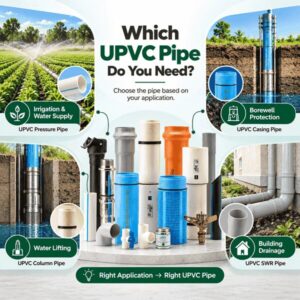
A simple way to understand UPVC pipes is to match the product type to the job it needs to perform.
| Your Requirement | Product Category to Consider |
|---|---|
| Agricultural irrigation or pressure-water supply | UPVC Pressure Pipe |
| Borewell casing | UPVC Casing Pipe |
| Water lifting with a submersible pump | UPVC Column Pipe |
| Soil, waste and rainwater drainage | UPVC SWR Pipe |
| Underground drainage | UPVC UDS Pipe |
| Suitable building plumbing applications | ASTM / appropriate plumbing pipe system |
Duke currently lists separate uPVC casing, column, pressure, SWR, UDS and ASTM plumbing systems in its product range.
Not Sure Which Pipe Fits Your Requirement?
If you are planning an irrigation, borewell, plumbing or drainage project, start with four details:
- Application: What will the pipe be used for?
- Size: What diameter is required?
- Quantity: How much pipe do you need?
- Project location: Where will the material be required?
If it is a pressure application, also share the required operating pressure if known.
These details make it easier to identify the relevant product category instead of selecting a pipe only by price or diameter.
What Are the Advantages of UPVC Pipes?
The suitability of a UPVC pipe depends on the specific product and application, but the material offers several useful characteristics.
Corrosion Resistance
UPVC does not rust in the same way as conventional iron-based piping materials.
This can be useful in applications where corrosion is a consideration.
Relatively Lightweight Construction
UPVC pipes are relatively lightweight compared with many traditional metallic pipe systems, which can make transportation and handling more manageable.
Smooth Internal Surface
A smooth internal pipe surface can support efficient fluid movement when the system is correctly sized, designed and installed.
Resistance to Many Chemicals
UPVC can resist many chemicals encountered in suitable water and drainage applications.
For industrial or unusual fluids, however, chemical compatibility should be checked according to the specific chemical, concentration, operating temperature and manufacturer’s guidance.
Multiple Application-Specific Systems
UPVC can be manufactured into different piping systems for:
- water supply,
- irrigation,
- borewells,
- plumbing,
- building drainage, and
- underground drainage.
The advantage is not that one pipe can perform every job. The advantage is that the same material family can be engineered into different systems for different applications.
PVC and UPVC: What Is the Difference?
PVC stands for Polyvinyl Chloride, while UPVC stands for Unplasticized Polyvinyl Chloride.
PVC is the broader material family. Depending on formulation, PVC products may be flexible or rigid.
UPVC specifically refers to the rigid, unplasticized form.
| Feature | PVC | UPVC |
|---|---|---|
| Full form | Polyvinyl Chloride | Unplasticized Polyvinyl Chloride |
| Material category | Broad PVC family | Rigid PVC formulation |
| Flexibility | Depends on formulation | Rigid |
| Plasticizers for flexibility | May be used in flexible PVC | Not added to create flexibility |
| Common context | Many flexible and rigid products | Rigid piping and construction applications |
In the pipe industry, terms such as PVC, uPVC and PVC-U may sometimes be used differently depending on technical standards or market terminology.
For buyers, the most useful approach is to check the actual product specification and intended application, rather than making a decision from the abbreviation alone.
UPVC vs CPVC: What Is the Difference?
UPVC and CPVC are different PVC-based materials intended for different operating requirements.
UPVC is widely used across rigid systems such as irrigation, pressure water, borewell and drainage applications, depending on the product.
CPVC stands for Chlorinated Polyvinyl Chloride and is commonly considered for plumbing systems where higher water-temperature capability is required.
The right choice depends on:
- operating temperature,
- pressure,
- application,
- installation environment, and
- required product specification.
For a dedicated comparison, read CPVC vs UPVC Pipes.
How to Choose the Right UPVC Pipe
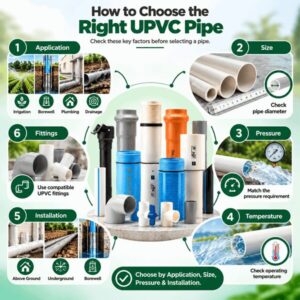
Choosing a UPVC pipe should begin with the application, not the price list.
1. Identify the Application
Ask first:
What does the pipe actually need to do?
Is it for:
- irrigation,
- pressurized water supply,
- borewell casing,
- submersible pumping,
- plumbing,
- building drainage, or
- underground drainage?
This usually identifies the correct product family.
2. Determine the Required Diameter
Diameter affects water flow and system design.
Do not automatically choose a size simply because an existing pipe looks similar.
The required size should match the project’s hydraulic and installation requirements.
3. Check the Pressure Requirement
For pressure-water applications, the pipe’s pressure class is important.
Duke’s current uPVC pressure-pipe technical table, for example, lists different pressure classes according to pipe size and wall thickness.
A drainage pipe should therefore not be treated as a substitute for a pressure-rated pipe.
4. Consider Operating Temperature
Fluid temperature can affect material selection.
If a plumbing system carries elevated-temperature water, confirm whether UPVC or another piping material is appropriate for that operating condition.
5. Consider Installation Conditions
A pipe installed inside a borewell operates under different conditions from one installed in building drainage or agricultural irrigation.
Check whether the system will be:
- underground,
- above ground,
- inside a building,
- inside a borewell, or
- connected to pumping equipment.
6. Check the Product Specification
Before purchasing, verify relevant information such as:
- pipe type,
- nominal size,
- pressure class where applicable,
- wall thickness,
- product standard,
- compatible fittings, and
- jointing requirements.
7. Use Compatible Fittings and Connections
The pipe and fittings should be part of a compatible system.
A correctly selected pipe can still perform poorly if unsuitable fittings or an incorrect jointing method are used.
Common Mistakes When Choosing UPVC Pipes
Understanding common selection mistakes can prevent confusion before purchase or installation.
Selecting a Pipe Only by Diameter
Two pipes can have a similar diameter while serving completely different purposes.
Diameter is only one selection factor.
Assuming Every UPVC Pipe Is Interchangeable
A pressure pipe, casing pipe, column pipe and SWR pipe are not simply different names for the same product.
Each is designed for a different application.
Confusing Casing Pipe and Column Pipe
A casing pipe is part of the borewell structure.
A column pipe carries water from a submersible pump.
They perform different functions.
Ignoring Pressure Requirements
A pipe designed for gravity drainage should not automatically be used in a pressurized water system.
Choosing Only by Lowest Price
The cheapest pipe is not automatically the correct pipe.
Selection should first consider:
- application,
- size,
- required pressure,
- installation conditions,
- specification, and
- compatible fittings.
Price comparison becomes meaningful only after these requirements are clear.
Need Help Choosing the Right UPVC Pipe?
If you know the application but are unsure which Duke product range fits the project, share your requirement with the Duke Pipes team.
For a more useful product inquiry, provide:
Application: Irrigation, borewell, plumbing, drainage or other use
Required size: If known
Pressure requirement: For pressure applications, if known
Quantity: Approximate requirement
Project location: City and state
This information helps the team understand your requirement before recommending the relevant product range.
Send Your Pipe Requirement to Duke Pipes
Frequently Asked Questions About UPVC
What is the full form of UPVC?
UPVC stands for Unplasticized Polyvinyl Chloride. It is a rigid form of PVC commonly used to manufacture pipes, fittings and other rigid construction products.
What does the “U” in UPVC mean?
The “U” means Unplasticized. It indicates that plasticizers are not added to the PVC formulation for the purpose of making the material flexible.
What is a UPVC pipe used for?
Different UPVC pipe systems can be used for applications such as irrigation, pressure-water supply, borewell casing, submersible pumping, plumbing and drainage. The correct pipe depends on the specific application and product specification.
Is UPVC the same as PVC?
UPVC belongs to the PVC material family, but it specifically refers to rigid, unplasticized PVC. PVC is a broader term that can include both rigid and flexible formulations.
What is the difference between UPVC and CPVC?
UPVC is a rigid unplasticized PVC material used in many water, borewell and drainage systems. CPVC is chlorinated PVC and is commonly used where plumbing systems require higher temperature capability. The correct choice depends on the operating conditions.
Which UPVC pipe is used for borewells?
It depends on the function. Casing pipe is used as part of the borewell casing system, while column pipe is used with a submersible pump to carry water upward. These two pipes should not be treated as interchangeable.
Which UPVC pipe is used for irrigation?
A suitable pressure-rated UPVC pipe may be used for irrigation and pressure-water distribution. The correct pipe diameter and pressure class should be selected according to the irrigation system’s requirements.
Final Takeaway
UPVC stands for Unplasticized Polyvinyl Chloride, but the material name alone should not determine which pipe you purchase.
The more important question is:
What does the pipe need to do?
Pressure pipes, casing pipes, column pipes, SWR pipes and underground drainage pipes serve different purposes. Choosing the correct system means considering the application, size, pressure, installation conditions and product specification together.
Duke Pipes currently manufactures multiple uPVC product systems for pressure-water, borewell, plumbing and drainage applications.
Explore the Duke Pipes uPVC Product Range, or contact Duke Pipes with your project requirement if you need help identifying the relevant product category.