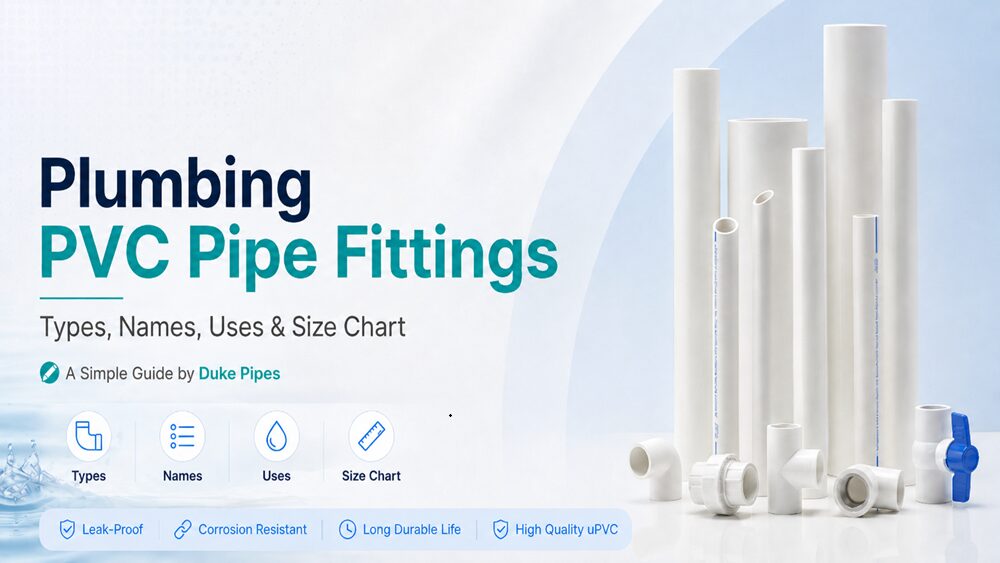
Plumbing PVC Pipe Fittings: Types, Names, Uses & Chart
Plumbing PVC pipe fittings are important parts of any piping system. They help connect pipes, change pipe direction, create branch lines, control water flow, reduce pipe size, and close pipe ends. A pipe system cannot work properly without the right fittings.
If the wrong fitting is selected, it can create problems like leakage, poor water flow, weak joints, wrong pressure handling, and extra repair work. That is why it is important to understand the correct fitting name, type, size, and use before choosing any plumbing product.
In India, PVC and uPVC pipe systems are widely used in residential, commercial, agriculture, drainage, SWR, pressure, and water supply applications. This guide by Duke Pipes explains plumbing PVC pipe fittings, including their types, names, uses, size chart, PVC vs uPVC vs CPVC difference, and selection tips.
What Are Plumbing PVC Pipe Fittings?
Plumbing PVC pipe fittings are connectors used to join, turn, reduce, divide, close, or control PVC/uPVC pipes in a plumbing system. Common fittings include elbow, tee, coupling, reducer, adapter, union, cap, plug, cross, and valve fittings.
These fittings help create a complete piping network for water supply, drainage, SWR systems, pressure lines, agriculture use, and other plumbing applications.
Why Are PVC/uPVC Fittings Important in Plumbing?
A pipe alone cannot complete a plumbing system. Fittings are needed to connect pipes and make the system useful. Whether it is a bathroom line, kitchen line, commercial building, drainage system, or agriculture pipeline, fittings help the piping system work properly.
PVC/uPVC fittings are important because they help in:
- Connecting two or more pipes
- Changing pipe direction
- Creating branch connections
- Reducing or increasing pipe size
- Closing pipe ends
- Controlling water flow
- Making maintenance easier
- Reducing leakage risk when installed correctly
A strong pipe system depends on both pipe quality and fitting quality. If the pipe is strong but the fitting is wrong, the complete system may become weak. That is why material, size, pressure rating, and application must be checked before installation.
PVC, uPVC and CPVC: Basic Difference Before Choosing Fittings
Before choosing plumbing fittings, it is important to understand the basic difference between PVC, uPVC, and CPVC. Many people use these terms together, but they are not exactly the same.
| Material | Full Form | Common Use | Key Point |
|---|---|---|---|
| PVC | Polyvinyl Chloride | Drainage, waste, cold water applications | Common plastic piping material |
| uPVC | Unplasticized Polyvinyl Chloride | Plumbing, SWR, pressure, agriculture, and water supply applications | Rigid, durable, and commonly used in piping |
| CPVC | Chlorinated Polyvinyl Chloride | Hot and cold water supply | Better heat resistance than regular PVC |
PVC may include plasticizers depending on product type, while uPVC is unplasticized, rigid, and commonly used for durable piping applications. CPVC is generally preferred where hot water handling is required.
Duke Pipes mainly focuses on durable uPVC and HDPE piping solutions, including ASTM Plumbing Pipe, uPVC SWR Pipe, uPVC Pressure Pipe, uPVC Casing Pipe, uPVC Column Pipe, HDPE Pipe, and HDPE Sprinkler Pipe.
For plumbing work, always choose fittings based on pipe material, application, pressure requirement, and temperature condition. PVC, uPVC, and CPVC should not be mixed without checking compatibility.
Plumbing Pipe Fittings Names With Uses
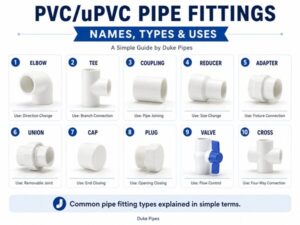
Here is a simple table of common plumbing pipe fittings names and their uses.
| Fitting Name | Main Use | Common Application |
|---|---|---|
| Elbow | Changes pipe direction | Bathroom, kitchen, drainage line |
| Tee | Creates branch connection | Main line to side line connection |
| Coupling | Joins two pipes | Pipe extension or repair |
| Reducer | Connects different pipe sizes | Large pipe to small pipe connection |
| Adapter | Connects pipe to threaded part | Tap, valve, fixture, or pump connection |
| Union | Creates removable joint | Maintenance areas |
| Cap | Closes pipe end | End sealing |
| Plug | Closes fitting opening | Threaded closing |
| Cross | Creates four-way connection | Complex piping layout |
| Valve | Controls water flow | Water supply and pressure control |
This plumbing pipe fittings names table helps users quickly understand which fitting is used for which purpose. It is useful for homeowners, plumbers, contractors, dealers, and buyers who want to understand all plumbing fittings in simple words.
Common Types of Plumbing PVC Pipe Fittings
There are many types of pipe fittings used in plumbing systems. Each fitting has a specific role. Below are the most common plumbing fittings types explained in simple words.
1. PVC Elbow Fitting
A PVC elbow fitting is used to change the direction of a pipe. It is one of the most common fittings used in plumbing systems.
Elbow fittings are usually available in different angles, such as 45-degree and 90-degree. A 90-degree elbow is used when the pipe needs a sharp turn. A 45-degree elbow is used when the pipe needs a smoother direction change.
Common uses:
- Bathroom drainage lines
- Kitchen plumbing
- Wall corner pipe connections
- Underground drainage
- Water supply layout
2. PVC Tee Fitting
A tee fitting looks like the letter “T”. It is used when one pipe line needs to divide into another direction.
For example, if a main water line needs to supply water to another bathroom, kitchen, garden, or utility area, a tee fitting can create that branch connection.
Common uses:
- Main line to side line connection
- Water supply branches
- Drainage branch lines
- Commercial plumbing layouts
- Agriculture pipe distribution
A tee fitting is very useful where one pipe line needs to serve multiple points.
3. PVC Coupling
A coupling is used to join two pipes in a straight line. It is simple but very useful in plumbing work.
Couplings are commonly used when a pipe needs to be extended or when a damaged pipe section needs to be repaired. Similar coupling fittings are also used in CPVC systems, but PVC/uPVC and CPVC fittings should always be matched with the correct pipe material.
Common uses:
- Joining two same-size pipes
- Pipe extension
- Repair work
- Straight pipe connection
- Maintenance work
A coupling fitting should match the pipe size properly. A loose or wrong-size coupling can create leakage issues.
4. PVC Reducer
A reducer fitting is used to connect pipes of different sizes. It helps reduce the pipe diameter from larger to smaller.
For example, if the main pipe is large but the connected pipe line is smaller, a reducer fitting is used to create a proper connection.
Common uses:
- Large pipe to small pipe connection
- Water flow adjustment
- Plumbing system transition
- Pressure and supply line connection
- Agriculture and utility piping
Reducers should be selected carefully because wrong size selection can affect water flow and joint strength.
5. PVC Adapter
An adapter fitting is used to connect a PVC/uPVC pipe to a threaded part, valve, tap, pump, or fixture.
In many plumbing systems, pipes need to connect with different types of parts. An adapter helps make that connection easy and secure.
Common uses:
- Tap connection
- Valve connection
- Pump connection
- Fixture connection
- Threaded plumbing connection
Adapters are useful where pipe systems meet fixtures or other equipment.
6. PVC Union
A union fitting creates a removable joint in the pipe system. It is different from a normal coupling because it can be opened and closed when required.
Union fittings are useful in places where future maintenance may be needed. For example, near pumps, filters, or machines, a union fitting helps remove or repair parts without cutting the pipe.
Common uses:
- Pump connection
- Filter connection
- Maintenance points
- Serviceable pipe joints
- Commercial plumbing systems
A union fitting is a smart choice for areas where regular inspection or repair may be required.
7. PVC Cap
A cap is used to close the open end of a pipe. It can be used for temporary or permanent closing.
If a pipe line is not being used or needs to be closed at the end, a cap fitting helps seal it properly.
Common uses:
- Pipe end closing
- Temporary sealing
- Permanent end closure
- Testing pipe lines
- Protecting pipe ends from dust and dirt
A cap helps protect the pipe system from dust, water leakage, and unwanted flow.
8. PVC Plug
A plug is also used for closing, but it is usually used to close the opening of a fitting rather than the end of a pipe.
Plugs are often used in threaded fittings or areas where the opening needs to be closed securely.
Common uses:
- Closing fitting openings
- Threaded connection closing
- Temporary closure
- Maintenance access points
Cap and plug may look similar in purpose, but they are used in different connection points.
9. PVC Cross Fitting
A cross fitting is used to create a four-way pipe connection. It has openings in four directions and can help distribute water or flow in multiple directions.
Cross fittings are not used as commonly as elbows, tees, or couplings, but they are useful in complex pipe layouts.
Common uses:
- Four-way pipe connection
- Complex plumbing network
- Industrial pipe systems
- Multi-direction water distribution
Cross fittings should be used carefully because wrong placement can affect pressure and flow balance.
10. PVC Valve Fitting
A valve fitting is used to control water flow. It helps start, stop, or manage the movement of water in a pipe system.
Valves are very important in plumbing because they allow users to control specific sections of the pipe network.
Common uses:
- Water supply line control
- Tank connection
- Pump line control
- Pressure system control
- Maintenance shut-off points
A good valve fitting helps make the plumbing system easier to manage and maintain.
11. Solvent Cement for PVC/uPVC Fittings
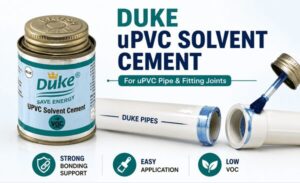
Solvent cement is used to join PVC/uPVC pipes and fittings. It creates a strong bond between the pipe and fitting when applied correctly.
Using the right solvent cement is important for leak-resistant installation. If the wrong adhesive is used, the joint may become weak and leakage can happen later.
Basic installation tips:
- Clean pipe and fitting before applying solvent cement
- Use compatible solvent cement
- Apply evenly on the joining area
- Join quickly after application
- Hold the joint for a short time
- Allow proper setting time before use
Duke uPVC solvent cement can be used as a relevant product image in this section.
Plumbing PVC Pipe Fittings Chart
A plumbing PVC pipe fittings chart helps users quickly understand which fitting should be used for which requirement.
| Plumbing Requirement | Best Fitting | Why It Is Used |
|---|---|---|
| Pipe direction change | Elbow | Turns pipe line at 45° or 90° |
| Branch line connection | Tee | Divides water flow into another line |
| Two pipes joining | Coupling | Connects same-size pipes |
| Size reduction | Reducer | Joins large and small pipe |
| Fixture connection | Adapter | Connects pipe to tap, valve, or threaded part |
| Maintenance point | Union | Allows easy removal and repair |
| Pipe end closing | Cap | Seals open pipe end |
| Opening closing | Plug | Closes fitting opening |
| Water flow control | Valve | Controls supply flow |
| Four-way connection | Cross | Creates multiple pipe directions |
This plumbing PVC pipe fittings chart can be used as a quick reference before buying or installing fittings.
Common PVC/uPVC Pipe Fitting Size Chart in India
Pipe and fitting size depends on the application, pressure rating, and plumbing layout. In India, many plumbing and drainage systems use sizes in millimeters. The final size should always be selected based on project requirements and expert guidance.
| Common Size | Common Use |
|---|---|
| 20mm | Small water supply lines and light plumbing use |
| 25mm | Home plumbing and branch water lines |
| 32mm | Medium water supply lines |
| 40mm | Utility lines and small drainage connections |
| 50mm | Wastewater and drainage applications |
| 63mm | Larger supply lines and pressure applications |
| 75mm | Drainage and SWR systems |
| 90mm | Larger drainage and utility lines |
| 110mm | Soil, waste, rainwater, and SWR applications |
This size chart is only a general reference. Actual size selection should depend on pipe type, pressure class, flow requirement, application, and local plumbing standards.
For important plumbing projects, always consult a plumber, dealer, engineer, or product expert before final selection.
How to Choose the Right PVC/uPVC Plumbing Fitting
Choosing the right fitting is very important for long-term plumbing performance. Here are the main points to check before selecting any fitting.
1. Check Pipe Material
First, check whether your pipe is PVC, uPVC, CPVC, or HDPE. Every material has a different use and performance level. Do not mix different materials without checking compatibility.
2. Check Pipe Size
Fitting size should match the pipe size. A wrong-size fitting can create loose joints, tight joints, or leakage problems.
3. Understand the Application
Different applications need different pipe and fitting types. For example:
- Drainage system
- Water supply system
- SWR system
- Pressure pipe system
- Agriculture piping
- Commercial plumbing
- Underground drainage
Select fittings based on the actual use.
4. Check Pressure Requirement
Pressure pipe systems need fittings that can handle pressure. Do not use normal drainage fittings in pressure applications.
5. Check Hot or Cold Water Use
For hot water applications, CPVC is usually preferred because it has better heat resistance. For other applications, PVC/uPVC may be suitable depending on the requirement.
6. Check ISI/BIS Marking and Quality
For reliable performance, always check quality standards, product marking, and application suitability. Certified and quality-tested piping products are better for long-term use.
7. Use Correct Solvent Cement
The joint between pipe and fitting should be strong. Always use compatible solvent cement and follow proper installation steps.
8. Choose a Trusted Manufacturer
Quality-tested pipes and compatible piping solutions can improve durability, reduce maintenance, and support better system performance. Duke Pipes offers durable uPVC and HDPE piping solutions for different residential, commercial, agriculture, borewell, drainage, pressure, and infrastructure applications across India.
Common Mistakes While Selecting Plumbing Fittings
Many plumbing problems happen because of wrong fitting selection or poor installation. Here are some common mistakes to avoid.
| Mistake | Problem | Better Solution |
|---|---|---|
| Wrong material selection | Leakage or joint failure | Match PVC/uPVC/CPVC correctly |
| Wrong size fitting | Loose or tight joint | Check pipe size before buying |
| Cheap fitting selection | Low durability | Choose quality-tested products |
| Wrong solvent cement | Weak bonding | Use compatible solvent cement |
| Ignoring application | System failure | Select fitting based on actual use |
| No expert guidance | Wrong product choice | Ask manufacturer, dealer, or plumber |
| Mixing hot and cold water products | Performance issue | Use CPVC for hot water needs |
| Ignoring pressure rating | Pipe or fitting damage | Choose pressure-suitable products |
| Ignoring quality marking | Low reliability | Check product standards and marking |
Avoiding these mistakes can help improve the life and performance of the plumbing system.
Where Are PVC/uPVC Pipe Fittings Used?
PVC/uPVC pipe fittings are used in many types of piping systems. Their use depends on material, design, size, and application.
Common applications include:
- Residential plumbing
- Commercial plumbing
- Bathroom and kitchen water lines
- Drainage systems
- SWR piping systems
- Water supply lines
- Pressure piping systems
- Agriculture water supply
- Borewell support systems
- Underground drainage
- Industrial water movement
- Utility piping work
- Rainwater management systems
For best results, pipe and fitting selection should always match the application requirement.
Duke Pipes Product Relevance
Duke Pipes is a Gujarat-based manufacturer of uPVC and HDPE piping solutions serving customers across India. The company offers products such as ASTM Plumbing Pipe, uPVC SWR Pipe, uPVC Pressure Pipe, uPVC Casing Pipe, uPVC Column Pipe, HDPE Pipe, and HDPE Sprinkler Pipe.
For plumbing and piping projects, choosing the right pipe and compatible fitting solution helps improve system performance, reduce leakage risk, and lower future maintenance issues.
Duke Pipes focuses on durable piping solutions for residential, commercial, agriculture, borewell, drainage, pressure, and infrastructure applications.
- Explore Duke Pipes Products
- Contact Duke Pipes
- Learn about uPVC SWR Pipe
- Explore ASTM Plumbing Pipe
- View uPVC Pressure Pipe Solutions
FAQs About Plumbing PVC Pipe Fittings
1. What are plumbing PVC pipe fittings?
Plumbing PVC pipe fittings are connectors used to join, turn, reduce, divide, close, or control PVC/uPVC pipes in a plumbing system. They help create a complete piping network for water supply, drainage, SWR, pressure, and other applications.
2. What are the common types of PVC pipe fittings?
Common types of PVC pipe fittings include elbow, tee, coupling, reducer, adapter, union, cap, plug, cross, and valve fittings. Each fitting has a specific purpose in pipe connection, direction change, flow control, or end sealing.
3. What is the difference between PVC and uPVC fittings?
PVC stands for Polyvinyl Chloride, while uPVC stands for Unplasticized Polyvinyl Chloride. uPVC is rigid and commonly used for durable piping applications such as plumbing, pressure systems, SWR systems, agriculture, and water supply applications.
4. What is CPVC full form?
CPVC stands for Chlorinated Polyvinyl Chloride. CPVC pipe fittings are commonly used for hot and cold water applications because CPVC has better heat resistance compared to regular PVC.
5. Which fitting is used to connect two pipes?
A coupling fitting is used to connect two pipes in a straight line. It is commonly used for pipe extension, repair work, and joining same-size pipe sections.
6. Which fitting is used to change pipe direction?
An elbow fitting is used to change pipe direction. Common elbow fittings are 45-degree and 90-degree elbows, depending on the required pipe angle.
8. What is a plumbing PVC pipe fittings chart?
A plumbing PVC pipe fittings chart is a simple reference table that shows fitting names, uses, and applications. It helps users quickly choose the right fitting for their plumbing requirement.
9. What is the use of a reducer fitting?
A reducer fitting is used to connect two pipes of different sizes. It helps change the pipe diameter from larger to smaller or smaller to larger, depending on the plumbing layout.
11. What are common PVC pipe fitting sizes in India?
Common PVC/uPVC pipe fitting sizes in India include 20mm, 25mm, 32mm, 40mm, 50mm, 63mm, 75mm, 90mm, and 110mm. Actual size selection depends on application, pressure rating, pipe type, and flow requirement.
12. How do I choose the right plumbing fitting?
To choose the right plumbing fitting, check pipe material, pipe size, application, pressure requirement, hot or cold water use, quality marking, and solvent cement compatibility. For important projects, take guidance from a plumber, dealer, or product expert.
Conclusion
Plumbing PVC pipe fittings play an important role in building a safe, durable, and leak-resistant piping system. From elbows and tees to couplings, reducers, adapters, unions, caps, plugs, crosses, and valves, every fitting has a specific purpose.
Before choosing any fitting, always check pipe material, size, pressure requirement, temperature condition, application, and quality marking. The right fitting can improve water flow, reduce leakage, and make maintenance easier.
Looking for durable uPVC plumbing pipes and compatible piping solutions? Contact Duke Pipes for product guidance across India.
Contact Duke Pipes:
https://www.dukepipes.com/contact-us/
About Duke Pipes
Duke Pipes Private Limited is an uPVC and HDPE piping solutions manufacturer located in Gujarat and catering to customers all over India. Since 1998, Duke Pipes has been in the business of durable piping solutions for residential, commercial, farm, borewell, drainage, pressure and infrastructure applications.
Duke Pipes provides you with the best choice of Piping Solutions like ASTM Plumbing Pipe, uPVC SWR Pipe, uPVC Pressure Pipe, uPVC Casing Pipe, uPVC Column Pipe, HDPE Pipe and HDPE Sprinkler Pipe.