uPVC vs HDPE Pipe: Difference, Uses & Which is Better? [2026 Guide]
Choosing the right pipe is critical for any water supply, irrigation, plumbing, borewell, or industrial project. The wrong piping material can lead to leakage, pressure failure, expensive maintenance, and reduced system life.
You can find uPVC pipes and HDPE pipes all over the place these days. Even though they are both strong and won’t rust, they are made for very different purposes.
HDPE and uPVC pipe are both commonly used in water systems, but many builders, engineers, farmers, and project owners get them mixed up. But what makes them different is how flexible they are, how well they work underground, how they are installed, and how long they last.
A lot of people look for “PVC vs. HDPE pipe,” but in industrial settings, the comparison is usually between uPVC and HDPE pipes, since uPVC is more rigid and can handle more pressure for structured systems. In this detailed guide, we will compare uPVC vs HDPE pipes based on:
- Strength & flexibility
- Pressure handling
- Underground performance
- Irrigation applications
- Borewell suitability
- Lifespan
- Price difference
- Installation method
- Real-world industrial use cases
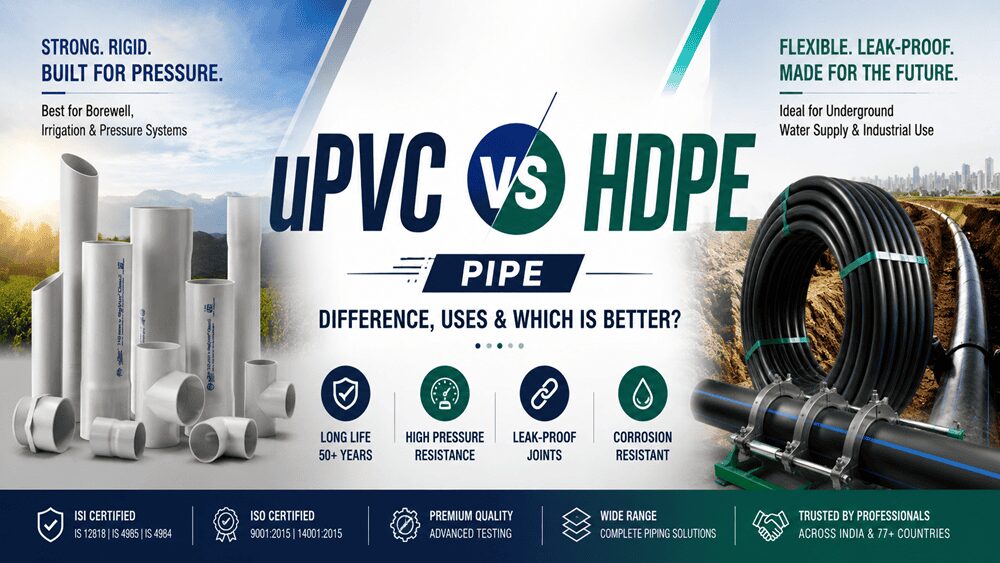
By the end of this article, you will clearly understand which pipe is better for your specific application. uPVC pipes are rigid, strong, affordable, and ideal for borewell casing, irrigation systems, pressure pipelines, and plumbing applications. HDPE pipes are highly flexible, impact-resistant, and best suited for underground water supply, industrial fluid transport, trenchless installation, and uneven terrain applications. In short:
- Choose uPVC pipes for strength, pressure, and cost efficiency.
- Choose HDPE pipes for flexibility and underground movement resistance.
What is uPVC Pipe?
uPVC (Unplasticized Polyvinyl Chloride) is a rigid thermoplastic pipe material widely used in irrigation systems, borewell casing, underground drainage, pressure pipelines, and industrial water transportation.
Unlike ordinary PVC, uPVC does not contain plasticizers, which makes it stronger, more durable, and suitable for high-pressure applications.
Modern uPVC pipes are manufactured according to industry standards such as:
- IS 4985:2021 – uPVC Pressure Pipes
- IS 12818:2010 – uPVC Screen & Casing Pipes
High-quality uPVC pipes are designed to withstand heavy hydrostatic pressure, underground soil load, and demanding environmental conditions.
Key Features of uPVC Pipes
- High tensile strength
- Corrosion-resistant
- Leak-resistant
- Lightweight
- Rust-free
- Long service life
- Smooth internal surface for better water flow
- Low maintenance
Common Applications of uPVC Pipes
- Borewell casing systems
- Agriculture irrigation
- Water supply lines
- Plumbing systems
- Underground drainage
- Industrial pipelines
- Submersible pump installations
For deep borewell applications, specially engineered uPVC casing pipes can support depths up to 450 meters, making them highly reliable for high-pressure underground systems. In short:
uPVC pipes are built for strength, durability, and long-term pressure performance.
What is HDPE Pipe?
HDPE (High-Density Polyethylene) pipe is a flexible thermoplastic piping system used for underground water supply, industrial pipelines, sewerage systems, gas distribution, and agricultural irrigation.
HDPE pipes are known for their excellent flexibility, impact resistance, and ability to absorb ground movement without cracking.
Unlike rigid piping systems, HDPE pipes can bend without breaking, making them ideal for uneven terrain, trenchless installations, and dynamic soil conditions. HDPE pipes are commonly manufactured according to:
- IS 4984:2016 – HDPE Pipes for Water Supply
Key Features of HDPE Pipes
- Highly flexible
- Crack-resistant
- Chemical-resistant
- UV resistant
- Suitable for underground installation
- Heat fusion jointing
- Excellent impact strength
Common Applications of HDPE Pipes
- Underground water supply
- Agriculture drip irrigation
- Sprinkler systems
- Industrial slurry transport
- Sewerage systems
- Telecom ducting
- Canal water transportation
- Municipal pipelines
One of the biggest advantages of HDPE pipes is their butt fusion jointing system, which creates a leak-proof and homogeneous pipeline. In short:
HDPE pipes are designed for flexibility, underground movement, and long-distance fluid transportation.
uPVC vs HDPE Pipe Comparison Table
| Feature | uPVC Pipe | HDPE Pipe |
|---|---|---|
| Structure | Rigid | Flexible |
| Flexibility | Low | Excellent |
| Pressure Strength | High | Very High |
| Jointing Method | Solvent/threaded | Butt fusion |
| Underground Use | Good | Excellent |
| Leak Risk | Moderate | Very Low |
| Corrosion Resistance | Excellent | Excellent |
| Lifespan | 50+ years | 50+ years |
| Irrigation Use | Excellent | Excellent |
| Borewell Use | Excellent | Limited |
| Chemical Resistance | High | Very High |
| Installation Cost | Lower | Higher |
| Initial Pipe Cost | Affordable | Expensive |
| Soil Movement Resistance | Moderate | Excellent |
| Maintenance | Low | Very Low |
Difference Between uPVC and HDPE Pipe
1. Strength & Pressure Handling
uPVC pipes are known for their rigid structure and excellent collapsing strength. They are widely used in:
- Borewell systems
- High-pressure irrigation
- Plumbing
- Underground drainage
High-grade uPVC pressure pipes are available in multiple schedules and pressure classes for demanding applications. HDPE pipes also offer strong pressure handling, especially under dynamic fluid movement. However, their main strength lies in flexibility rather than rigidity.
Which is Better?
- For rigid high-pressure applications → uPVC
- For dynamic underground movement → HDPE
2. Flexibility & Bending Capability
This is one of the biggest differences between HDPE and uPVC pipes.
uPVC Pipes
uPVC pipes are rigid and cannot bend without fittings. Elbows and joints are required for directional changes.
HDPE Pipes
HDPE pipes are highly flexible and can bend naturally without cracking. This reduces the need for additional fittings and allows easier installation in uneven terrain.
Best Choice
- Straight pipelines → uPVC
- Curved underground layouts → HDPE
3. Jointing & Leakage Risk
uPVC Pipes
uPVC pipes are joined using:
- Solvent cement
- Rubber ring joints
- Threaded systems
Improper installation may increase leakage risk over time.
HDPE Pipes
HDPE pipes use:
- Butt fusion welding
- Electrofusion welding
This creates a monolithic leak-proof pipeline with extremely low joint failure risk.
Best Choice
- For leak-proof underground systems → HDPE
- For affordable standard installations → uPVC
4. Underground Performance
Both piping systems can be used underground, but their behavior differs significantly.
uPVC Pipes
uPVC performs well in stable underground conditions and is widely used for:
- Borewell casing
- Water supply
- Underground drainage
HDPE Pipes
HDPE performs exceptionally well in:
- Shifting soil
- Earthquake zones
- Uneven terrain
- Trenchless boring
Its flexibility helps absorb structural movement without cracking.
Best Choice
- Stable underground systems → uPVC
- Dynamic soil conditions → HDPE
5. Borewell Applications
This is where uPVC pipes dominate. Specially engineered uPVC casing pipes are designed for:
- Deep borewell installations
- Hydrostatic pressure handling
- Heavy soil load resistance
Advanced casing series can support:
- CS Series → up to 80m
- CM Series → up to 150m
- CD Series → up to 450m depth
HDPE pipes are generally not preferred for deep borewell casing because rigid structural support is required.
Best Choice for Borewell
uPVC Pipe
6. Irrigation Applications
Both pipes are widely used in agriculture irrigation systems.
uPVC Pipes
Best for:
- Main irrigation supply lines
- Fixed agricultural systems
- Pressure pipelines
HDPE Pipes
Best for:
- Drip irrigation
- Flexible layouts
- Long-distance field water transportation
Best Choice
- Fixed irrigation system → uPVC
- Flexible agriculture layouts → HDPE
7. Lifespan & Durability
Both uPVC and HDPE pipes can last over 50 years with proper installation.
uPVC Pipes
Advantages:
- Rust-free
- Chemical resistant
- UV stabilized
- Long-term pressure handling
HDPE Pipes
Advantages:
- Impact resistant
- Crack resistant
- Freeze/thaw resistant
- Excellent underground durability
Lifespan Verdict
Both pipes offer excellent long-term durability.
8. Temperature Resistance
uPVC Pipes
Suitable for normal water transportation but not recommended for continuous high-temperature applications.
HDPE Pipes
Can handle wider temperature variation and freezing conditions more effectively.
Best Choice
- Normal water systems → uPVC
- Extreme environmental conditions → HDPE
9. Price Difference
uPVC Pipes
- Lower material cost
- Lower installation cost
- Affordable maintenance
HDPE Pipes
- Higher initial material cost
- Fusion welding equipment required
- Higher installation investment
However, HDPE may reduce long-term leakage and maintenance expenses.
Cost Verdict
- Budget-friendly projects → uPVC
- Long-term underground projects → HDPE
Which Pipe is Better for Irrigation?
Both pipes perform well in irrigation systems, but the best choice depends on the application.
Choose uPVC Pipe When:
- You need rigid pressure pipelines
- Installation layout is straight
- Budget is limited
- High-pressure delivery is required
Choose HDPE Pipe When:
- Fields have uneven terrain
- Flexible layout is needed
- Long-distance water transportation is required
Which Pipe is Better for Underground Water Supply?
For underground municipal and industrial water supply systems:
HDPE Pipes are Usually Better Because:
- Flexible structure absorbs soil movement
- Leak-proof fusion joints
- Excellent resistance to underground stress
- Suitable for trenchless installation
However, for standard underground pressure lines in stable conditions, uPVC remains highly reliable and economical.
Which Pipe is Better for Borewell?
For borewell systems:
uPVC pipes are clearly the better choice.
Why?
- Higher collapsing strength
- Excellent hydrostatic pressure resistance
- Deep installation support
- Strong threaded systems
- Better rigidity for vertical underground systems
This is why most borewell contractors and submersible pump installers prefer high-quality uPVC casing and column pipes.
Real-World Industrial Applications
uPVC Real Use Cases
- Deep borewell casing
- Agriculture pressure pipelines
- Underground drainage systems
- High-rise building plumbing
- Industrial water supply
HDPE Real Use Cases
- Canal water transportation
- Smart city underground drainage
- Industrial slurry movement
- Gas distribution
- Municipal water supply
Why Professionals Choose Duke Pipes
For over 25+ years, Duke Pipes has been manufacturing advanced piping solutions for agriculture, plumbing, borewell, and industrial applications.
Duke Pipes Manufacturing Strengths
- Advanced automated manufacturing
- CAD/CAM-based R&D systems
- Fully automatic testing labs
- Strict quality control processes
- Pan-India distribution network
- Export presence across multiple countries
Certifications & Standards
- IS 12818:2010
- IS 4985:2021
- IS 4984:2016
- ISO 9001:2015
- ISO 14001:2015
- ZED Gold Certification
The company is also recognized with a prestigious National Quality Award for manufacturing excellence.
Expert Recommendation
Based on real-world industrial applications:
Choose uPVC Pipes If:
- You need borewell casing
- You want affordable pressure pipelines
- You need rigid irrigation systems
- You require long-term pressure performance
Choose HDPE Pipes If:
- Underground flexibility is critical
- Soil movement is expected
- Trenchless installation is required
- Leak-proof underground transport is necessary
FAQs
Which is better: uPVC or HDPE pipe?
Both are excellent, but the best choice depends on the application. uPVC is better for borewell and rigid pressure systems, while HDPE is ideal for underground flexible pipelines.
Is HDPE pipe stronger than uPVC?
HDPE offers better flexibility and impact resistance, while uPVC provides better rigidity and collapsing strength.
Which pipe lasts longer underground?
Both pipes can last over 50 years when installed properly.
Which pipe is best for irrigation?
uPVC is excellent for fixed pressure irrigation systems, while HDPE is better for flexible field layouts and long-distance water transportation.
Which pipe is best for borewell?
uPVC casing pipes are the preferred choice for deep borewell applications.
Conclusion
Both uPVC pipes and HDPE pipes are highly durable and reliable piping systems, but they are engineered for different purposes.
Choose uPVC Pipes For:
- Borewell systems
- Pressure pipelines
- Irrigation systems
- Underground drainage
- Cost-effective water transportation
Choose HDPE Pipes For:
- Underground municipal supply
- Flexible installations
- Industrial fluid movement
- Uneven terrain applications
- Leak-proof long-distance pipelines
If you are looking for strength, affordability, and high-pressure performance, uPVC pipes are an excellent choice. If flexibility and underground movement resistance are your priority, HDPE pipes are the better option.
Need Expert Help Choosing the Right Pipe?
Duke Pipes manufactures high-quality uPVC and HDPE piping systems for:
- Borewell Applications
- Irrigation Systems
- Underground Water Supply
- Industrial Pipelines
- Plumbing & Drainage
Contractors, engineers, dealers, and farmers all over India trust Duke Pipes because they have been making pipes for more than 25 years, have state-of-the-art testing facilities, and make goods that are ISI-certified. Contact Duke Pipes today and choose the right piping solution for long-term performance.