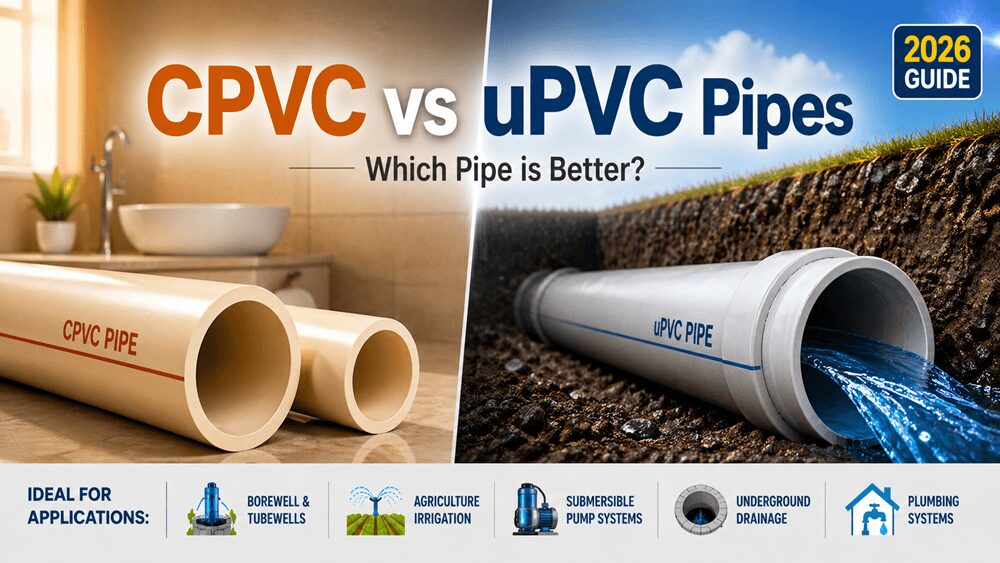
CPVC vs uPVC Pipes: Difference, Price, Uses & Which Is Better?
CPVC and uPVC pipes often look similar, which is why many buyers assume they can be used for the same purpose. In reality, both materials are designed for different piping conditions.
The simplest difference is:
CPVC is commonly used for hot and cold water plumbing, while uPVC is widely used for cold-water supply, irrigation, borewell casing, drainage and other application-specific piping systems.
So, CPVC vs uPVC—which is better?
There is no single winner for every project. CPVC is generally the more suitable option for hot-water plumbing. For applications such as agriculture, borewell casing, cold-water distribution and underground drainage, the correct type of uPVC pipe may be more appropriate.
Before choosing either pipe, consider:
- Water temperature
- Working pressure
- Installation location
- Intended application
- Applicable pipe standard
This guide explains the difference between CPVC and uPVC pipes, including their uses, price, pressure capability, durability and which one to choose for different applications.
CPVC vs uPVC: Quick Comparison
| Factor | uPVC Pipe | CPVC Pipe |
|---|---|---|
| Full Form | Unplasticized Polyvinyl Chloride | Chlorinated Polyvinyl Chloride |
| Common Uses | Irrigation, cold-water supply, borewell casing, drainage | Hot and cold water plumbing |
| Hot Water Use | Generally not used for standard hot-water plumbing | Suitable when correctly rated |
| Corrosion Resistance | Yes | Yes |
| Pressure Capability | Depends on size, class and application | Depends on size, class and temperature |
| Borewell Use | Purpose-designed casing pipes available | Not commonly used |
| Irrigation Use | Commonly used | Not normally selected |
| Building Plumbing | Mainly cold-water/application-specific use | Hot and cold plumbing |
| Cost | Often more economical for cold-water applications | Usually higher |
| Selection Basis | Application + pressure class | Temperature + pressure rating |
CPVC is generally better suited to hot-water plumbing, while uPVC is commonly used for irrigation, potable cold-water supply, borewell casing and drainage. Neither pipe is universally better—the right choice depends on the application, pressure and temperature requirements.
What Is the Difference Between CPVC and uPVC?
The main difference between CPVC and uPVC is their material formulation, temperature capability and typical application.
uPVC is a rigid form of PVC made without added plasticizers. Different uPVC piping systems are manufactured for applications such as agriculture, water supply, borewells and drainage.
CPVC is PVC that undergoes an additional chlorination process. This improves its temperature resistance, making it suitable for hot and cold pressurised water distribution.
ASTM D2846/D2846M-24 covers certain CPVC hot and cold potable-water distribution systems with service temperatures up to 82°C.
The practical comparison is therefore not simply:
“Which material is stronger?”
A better question is:
“Which pipe is designed for my required temperature, pressure and application?”
What Is a uPVC Pipe?
uPVC stands for Unplasticized Polyvinyl Chloride.
It is a rigid thermoplastic commonly used in water supply, agriculture, borewell and drainage systems.
An important point is that all uPVC pipes are not the same.
Different uPVC products are manufactured according to different standards and applications.
For example:
- IS 4985:2021 covers uPVC pipes for potable water supplies.
- IS 12818:2010 covers PVC-U screen and casing pipes for bore/tubewells.
- IS 13592:2013 covers specified PVC-U soil, waste, ventilation and rainwater applications.
This means a pressure pipe, casing pipe and drainage pipe may all be made from uPVC, but they should not be treated as interchangeable products.
Common Uses of uPVC Pipes
Depending on the product type and specification, uPVC pipes are commonly used for:
- Agricultural irrigation
- Potable cold-water supply
- Borewell and tubewell casing
- Underground water distribution
- Soil and waste systems
- Underground drainage
- Selected industrial water applications
For agriculture and water distribution, Duke offers uPVC Pressure Pipes in multiple sizes and pressure classes.
What Is a CPVC Pipe?
CPVC stands for Chlorinated Polyvinyl Chloride.
It belongs to the PVC family, but its modified material structure provides better resistance to higher water temperatures than standard uPVC.
CPVC is commonly used in:
- Hot-water plumbing
- Cold-water plumbing
- Bathrooms
- Kitchens
- Residential buildings
- Hotels
- Hospitals
- Commercial plumbing systems
One common misconception is that CPVC is used only for hot water.
That is not completely accurate.
CPVC piping systems can be designed for both hot and cold pressurised water distribution.
Its main advantage in building plumbing is its higher temperature capability.
CPVC vs uPVC Pipes: Detailed Comparison
1. Temperature Resistance
Temperature is one of the clearest differences between CPVC and uPVC.
CPVC
CPVC is commonly selected where higher water temperatures are expected.
Certain CPVC systems covered by ASTM D2846/D2846M-24 are intended for hot and cold water service at temperatures up to 82°C.
This makes CPVC suitable for applications such as:
- Geyser outlet lines
- Bathroom hot-water supply
- Kitchen hot-water lines
- Residential plumbing
uPVC
uPVC is generally selected for cold-water and application-specific systems rather than conventional hot-water plumbing.
Simple decision:
Hot-water plumbing → CPVC
Cold-water irrigation, borewell or drainage → appropriate uPVC system
2. CPVC vs uPVC Pressure Capacity
It is not technically correct to say that all uPVC pipes handle high pressure while all CPVC pipes handle medium pressure.
The actual pressure capacity depends on:
- Pipe diameter
- Wall thickness
- Pressure class
- Material grade
- Operating temperature
- Product standard
Duke’s uPVC pressure pipes, for example, are available across multiple pressure classes for agriculture, irrigation, water supply and industrial applications.
Expert Tip
Instead of asking:
“Which is stronger: CPVC or uPVC?”
Ask:
“What pressure rating does this exact pipe size and class provide at my operating temperature?”
That gives you a more reliable answer.
3. CPVC vs uPVC Price Difference
The CPVC vs uPVC price difference is a common buying question, but there is no fixed percentage that applies to every product.
CPVC is often more expensive than comparable uPVC cold-water piping because its material and temperature-performance requirements are different.
Actual pipe pricing depends on:
- Diameter
- Wall thickness
- Pressure class
- Pipe series
- Brand
- Quantity
- Length
- Location
- Raw-material cost
Which Is Cheaper: CPVC or uPVC?
For many cold-water and irrigation applications, uPVC is generally more economical.
However, price should not be compared without considering the application.
A CPVC hot-water plumbing pipe and a uPVC borewell casing pipe perform completely different jobs, so comparing them only by cost per metre can be misleading.
4. Corrosion Resistance
Both CPVC and uPVC are polymer-based piping materials and do not rust like conventional ferrous metal pipes.
This makes both materials useful where corrosion resistance is important.
For industrial or chemical applications, however, chemical compatibility should always be checked against the manufacturer’s technical data.
5. Maintenance
When the correct pipe is selected and installed properly, both materials can offer low-maintenance performance.
Most piping problems are more likely to occur because of:
- Incorrect pipe selection
- Poor jointing
- Wrong fittings
- Excessive pressure
- Operating beyond temperature limits
- Improper installation
Therefore, maintenance depends not only on the material but also on how correctly the system is designed and installed.
CPVC vs uPVC for Hot Water
For normal hot-water building plumbing, CPVC is generally the more appropriate option.
Its higher temperature capability makes it suitable for applications such as:
- Bathroom hot-water lines
- Kitchen hot-water lines
- Geyser connections
- Residential plumbing
- Hotels
- Commercial buildings
Always check the selected CPVC system’s temperature and pressure rating before installation.
CPVC vs uPVC for Cold Water
Both CPVC and uPVC can be used in cold-water applications, but they are generally selected for different systems.
CPVC may be used as part of a building’s complete hot and cold plumbing network.
uPVC is commonly used for:
- Agriculture
- Irrigation
- Potable water distribution
- Water supply pipelines
- Borewell systems
For large agricultural water networks, a suitable uPVC pressure pipe may be more relevant than a CPVC building-plumbing system.
CPVC vs uPVC for Borewell
For borewell casing, purpose-designed uPVC casing pipes are commonly used.
IS 12818:2010 covers PVC-U screen and casing pipes for bore/tubewells.
Duke manufactures uPVC Casing Pipes in different configurations for borewell and tubewell applications.
Current Duke casing configurations include:
- CS Series
- CM Series
- CD Series
- RMS screens
- RDS screens
- PMS screens
- PDS screens
The correct casing pipe should be selected according to:
- Bore diameter
- Bore depth
- Geological conditions
- Pipe dimensions
- Screen requirement
- Installation conditions
Practical Tip
Do not select a casing pipe only because someone recommends a “4-inch” or “6-inch” pipe.
Always compare actual outside diameter, wall thickness, pipe series and bore conditions.
CPVC vs uPVC for Irrigation
For agricultural cold-water distribution, uPVC pressure pipes are widely used.
Duke’s uPVC pressure pipe range is designed for agriculture, irrigation, water supply and selected industrial applications.
When choosing an irrigation pipe, consider:
- Pump pressure
- Pipe diameter
- Total pipeline length
- Elevation difference
- Required water flow
- Irrigation method
- Pressure loss
A sprinkler irrigation line may require a different pressure class than a simple farm water-transfer line.
This is why diameter alone should never be the only selection factor.
CPVC vs uPVC for Submersible Pump Systems
A borewell system includes different pipe components.
The casing pipe lines and supports the bore.
The column pipe connects to the submersible pump and carries water upward.
For this purpose, purpose-designed uPVC Column Pipes can be used. Duke currently offers column pipe ranges from 1 inch to 6 inches across different duty categories.
This distinction is important because saying only “use uPVC pipe” does not explain which uPVC product the system actually needs.
CPVC vs uPVC for Underground Drainage
For underground drainage, a pipe specifically designed for drainage applications should be selected.
A pressure pipe, casing pipe and drainage pipe may all use uPVC material, but they differ in:
- Pipe design
- Wall dimensions
- Joint system
- Load requirements
- Intended use
Duke also manufactures uPVC SWR Pipes for soil, waste and rainwater applications under IS 13592:2013.
So instead of asking:
“Can uPVC be used underground?”
Ask:
“Is this specific uPVC pipe designed for my drainage application?”
Which Is More Durable: CPVC or uPVC?
There is no universal answer that CPVC or uPVC always lasts longer.
Durability depends on whether the selected pipe is used within its intended operating conditions.
Important factors include:
- Temperature
- Pressure
- Installation environment
- Chemical exposure
- Jointing method
- Product quality
- Installation practices
A CPVC hot-water pipe installed correctly in a building and a uPVC irrigation pipe installed correctly on a farm are performing different jobs.
Both can provide reliable service when used correctly.
CPVC vs uPVC: Which Is Better?
The answer depends on the application.
| Application | Generally Suitable Choice |
|---|---|
| Hot-water plumbing | CPVC |
| Hot and cold building plumbing | CPVC where specified |
| Agriculture | uPVC pressure pipe |
| Irrigation | uPVC pressure pipe |
| Borewell casing | uPVC casing pipe |
| Submersible pump column | uPVC column pipe |
| Potable cold-water supply | Suitable certified uPVC system |
| Underground drainage | Application-specific uPVC drainage pipe |
Bottom Line
Choose CPVC when higher-temperature plumbing is required.
Choose an appropriate uPVC pipe system for applications such as irrigation, borewell casing, cold-water supply or drainage.
Neither material should be selected only because it is cheaper or because someone describes it as “stronger.”
How to Choose Between CPVC and uPVC
Before buying either pipe, check these five points.
1. Is the Water Hot or Cold?
If hot water will flow through the pipe, temperature rating should be the first consideration.
CPVC is generally the more relevant choice for hot-water plumbing.
2. What Working Pressure Is Required?
Check the pressure class of the exact pipe size you plan to use.
Do not assume every pipe made from the same material has the same pressure rating.
3. Where Will the Pipe Be Installed?
Bathroom plumbing, farm irrigation, borewell casing and underground drainage all have different technical requirements.
4. Which Standard Applies?
Check the relevant BIS, ASTM or project-required standard.
Examples include:
- IS 4985:2021 → uPVC potable water supply pipes
- IS 12818:2010 → PVC-U bore/tubewell screen and casing pipes
- IS 13592:2013 → PVC-U soil, waste and rainwater systems
- ASTM D2846/D2846M → CPVC hot and cold water distribution systems
5. What Does the Technical Specification Say?
Always check:
- Pipe diameter
- Wall thickness
- Pressure class
- Temperature limit
- Joint type
- Pipe series
- Installation recommendations
Technical data is more reliable than generic labels such as “heavy duty” or “high strength.”
Common Mistakes When Comparing CPVC and uPVC
Mistake 1: Assuming All uPVC Pipes Are the Same
They are not.
A uPVC pressure pipe, casing pipe, column pipe and drainage pipe are designed for different applications.
Mistake 2: Saying CPVC Is Only for Hot Water
CPVC can also be used for cold-water plumbing when the system is designed for both hot and cold distribution.
Mistake 3: Comparing Only Price
A cheaper pipe is not economical if it is unsuitable for the required application.
Mistake 4: Ignoring Pressure Class
Two pipes with the same nominal diameter may have different wall thicknesses and pressure ratings.
Mistake 5: Choosing Borewell Pipe Only by Inch Size
Actual outside diameter, pipe series, wall thickness and bore conditions should also be checked.
Practical Example: Which Pipe Should You Select?
Project 1: Bathroom with Geyser
The pipe will carry hot water inside a residential building.
Suitable direction: A CPVC plumbing system rated for the required temperature and pressure.
Project 2: Farm Irrigation Pipeline
The pipe will carry cold water from a pump across an agricultural field.
Suitable direction: A uPVC pressure pipe selected according to pipe diameter, working pressure and required water flow.
Project 3: Borewell Casing
The pipe will support and line a drilled borewell.
Suitable direction: A uPVC casing pipe selected according to bore diameter, depth, geological conditions and appropriate series.
These examples show why asking only “CPVC or uPVC—which is better?” does not provide the full answer.
Why Correct Pipe Selection Matters
Using the wrong pipe can lead to:
- Leakage
- Joint failure
- Pressure loss
- Shorter service life
- Higher repair costs
- Difficult maintenance
- Poor system performance
The pipe material matters, but matching the pipe to the application matters even more.
For farmers, contractors, engineers and homeowners, it is better to compare technical specifications first and price second.
About Duke Pipes
Duke Pipes has been manufacturing uPVC and HDPE piping solutions since 1998 from Gujarat.
Its current product range includes:
- uPVC Pressure Pipes
- uPVC Casing Pipes
- uPVC Column Pipes
- SWR Pipes
- Underground Drainage Pipes
- ASTM Plumbing Pipes
- HDPE Pipes
- HDPE Sprinkler Pipes
Duke currently serves customers through a wide dealer and distributor network across India and international markets.
When selecting a Duke product, always match the pipe specifications to actual project requirements rather than choosing only by product name or price.
FAQs About CPVC vs uPVC Pipes
What is the main difference between CPVC and uPVC?
The main difference is temperature capability and typical application. CPVC is commonly used for hot and cold building plumbing, while uPVC is widely used for irrigation, cold-water supply, borewell casing and drainage systems.
CPVC or uPVC—which is better?
Neither material is better for every application. CPVC is generally better suited to hot-water plumbing, while the correct uPVC system may be more suitable for irrigation, borewells, cold-water distribution and drainage.
What is the price difference between CPVC and uPVC?
CPVC is generally more expensive than comparable uPVC cold-water piping. However, the actual price difference depends on diameter, wall thickness, pressure class, brand, quantity and application.
Is uPVC cheaper than CPVC?
For many comparable cold-water applications, uPVC is usually more economical. However, two pipes designed for different applications should not be compared only by price.
Can uPVC be used for hot water?
Ordinary uPVC cold-water pipes should not be used beyond their rated temperature range. For hot-water building plumbing, an appropriately rated CPVC system is generally selected.
Can CPVC be used for cold water?
Yes. CPVC can be used for both hot and cold water when the piping system is designed and rated for those conditions.
What is the full form of CPVC?
CPVC stands for Chlorinated Polyvinyl Chloride.
What is the full form of uPVC?
uPVC stands for Unplasticized Polyvinyl Chloride.
Which pipe is better for borewell casing?
Purpose-designed uPVC casing pipes are commonly used for borewell and tubewell applications. In India, IS 12818:2010 covers PVC-U screen and casing pipes for bore/tubewells.
Which pipe is better for irrigation?
An appropriately sized and pressure-rated uPVC pressure pipe is commonly used for agricultural irrigation. Selection should consider pump pressure, required flow, pipe diameter and installation conditions.
Which is stronger: CPVC or uPVC?
There is no useful universal answer. Strength and pressure capability depend on the exact product, pipe diameter, wall thickness, pressure class, temperature and standard.
Final Takeaway: CPVC vs uPVC Pipes
The difference between CPVC and uPVC pipes becomes easier to understand when you compare them according to application rather than material name alone.
For hot-water building plumbing, CPVC is generally the more suitable choice.
For irrigation, potable cold-water supply, borewell casing, submersible pump systems and drainage, the appropriate type of uPVC pipe is commonly used.
Before purchasing, follow this simple sequence:
Application → Temperature → Pressure → Pipe Standard → Technical Specification
This gives you a much more reliable basis for choosing a pipe than simply asking which material is cheaper, stronger or better.
Need Help Choosing the Right Pipe?
If you are selecting a pipe for irrigation, borewell, water supply or drainage, first confirm the required size, pressure class and application.
Duke Pipes provides detailed technical specifications across its uPVC product range to help farmers, contractors, engineers, dealers and project buyers choose the right piping solution.